"Cows are my passion. What I have ever sighed for has been to retreat to a farm and live entirely surrounded by cows–and china." Charles Dickens
Showing posts with label Bookshelf. Show all posts

November 2, 2011

Schisms

A tranquil ravine behind the Laura Ingalls Wilder farm in Mansfield, Missouri.

We all have experienced schisms in our lives: with friends, family members, ideologies, in companies, nonprofit organizations and even churches. Some rifts quickly fuse back together, some are narrow enough to hop over and others are so wide that they are impassable. Lately I've been troubled by the widening gap created in our local Old Order Mennonite community. It is sad and disheartening, so unnecessary to those of us who are on the outside looking in or who know many of them as friends or neighbors. While I can't go into great detail here or all of the history–much of which I don't know or understand–the usual cast of characters is involved: Ego, Pride, Righteousness (and I will add, Male, as their religion is set up as a complete patriarchy). As a friend of mine back in New Hampshire has observed, in any church split or religious issue the women are usually the ones who suffer the most. She couldn't be more right about that in this case.

Young Buddhist monks (photograph from the website ReligionFacts.com)

"How do you want to create peace
if there is no peace inside yourselves?"
~ Thich Nhat Hanh


I have friends on both sides of the divide and they, too, are also friends with each other. A couple, quite close to us, is even experiencing the divide within their own home. As individuals in the local community they are all friends or at least friendly and charitable with each other and community-natured. But when it comes to church rules and personal conduct, they are divided. So much so that the splinter group that decided to leave the original church several years ago (which is part of the larger Groffdale Old Order Mennonite Conference that settled here initially) have now been told to leave the area by a group of bishops in the established conference. It has reached a point where there is no resolution and the group that has left the original church–that has sought even stricter rules of conduct from how they all were raised in the church (or "man's law" vs. "God's law")–has been given a finite period of time to sell their farms and businesses and move away from those from whom they wish to worship separately. They certainly understand that they are free to worship as they please–which is why the Mennonites and Amish came here from Germany and Switzerland in the first place–but because their religion and lifestyle is so intricately meshed, church splits in their communities effect all areas of their lives. Thus, major whole-herd moves as the result of dissension are not uncommon. [As for the financial ramifications in this economy, I can't even begin to ponder it.]

Hay on the knob and the Morgan Cemetery, Hickory Nut Ridge, Summer 2009.
"I'm a Protestant atheist. [Philip Larkin's poem, Church Going, captures his attitude] to religion, tradition, faith, 
architecture, Englishness, Larkin's admirable stoicism. 
Larkin very much wanted to be a believer, and couldn't do it. 
And he was petrified of death."
~ Christopher Hitchens
[as quoted in an article in The Sydney Morning Herald]


I asked the other day, in the car, with several Mennonite friends that I took on errands, "Where is God in all of this?" Does God care where we worship or how, or even with whom? Even though we would like to find a church that works for us, I have believed for a very long time that we can avoid the middle man–the Church–and go right to the source: God. My favorite cathedral these days is among the open fields of our farm or in the quiet Kentucky woods. In nature do we see God's greatest glories and sometimes the very harsh realities and tempests.

Gertie and John, Valley View Farm, December 2010.
"Trouble no one about their religion, respect all in their views, 
and demand that they respect yours."
~ Chief Tecumseh

Church does serve a great purpose: it binds people in community and fellowship and it provides a place and time each week for pause, prayer and reflection. There are rituals and rites and there can be great beauty and comfort in them. Church, as a structure, can even provide the setting for magnificent music and great art and architecture. But it can also split and fracture and wound. The blood-letting can be gradual or immediate but there is pain either way. That pain doesn't come from a holy place but from the man-made and the mundane.

Exit gate at the Cathedral of the Pines,
Rindge, New Hampshire, June 2009.
"We must learn to live 
together as brothers, 
or we are going to perish 
together as fools."
~ Martin Luther King

The Bible provides a code of conduct for pre-Christians (especially in the The Old Testament) and later Christians with the word of Christ, but so much is no longer applicable, particularly in the Old Testament, to our lives today. There are too many examples to name here but we also know that the Bible does not explicity say that we are supposed to live separately but equally, while celibate (eg. the United Society of Believers, aka Shakers, who actually believed in a dual deity of Mother and Father); or to have many wives (Old Order Mormons); or live without electricity, modern conveniences, automobiles or tractors (eg. the Amish and some Old Order Mennonites); or to even have a Pope. Those differences are all from human intervention and decision-making. As long as no one is hurting anyone else, why not? I respect people's individual journeys, even if I don't always understand them.

Lupines by a Vermont brook, June 2009.
"Our view is that there is truth and holiness in other religious faiths. Our view is that there are many paths to God."
~ Rabbi Eric Yoffee

The Bible is a template for living for those who wish to follow it, just as there are comparative texts in other religions such as Judaism, Buddhism, Hinduism, and Islam, to name a few. Some even share the same texts, such as parts of the Old Testament in the Bible, Torah and Koran. But I believe there is one creator and that he/she/it very likely came to different people throughout the world and in different times as the same entity or embodiment, only with different personas. In other words, religious pluralism.

My favorite mountain in the whole world, the Grand Monadnock,
taken from Sawyer Farm, Jaffrey, New Hampshire, June 2009.
"There are many paths up the Mountain, 
but the view of the moon from the top is the same."
~ Ancient Japanese saying

It would seem that there are so many schisms now in our society. Our political world has never been so divisive (and, ironically, because religion is often thrown out there into the mix). We are disconnected in so many ways from each other and with ourselves. The rise in drug use and substance abuse has never been greater. Our economy, and the world's, is a house of cards and collapsing everywhere. If ever there was a time to come together it is now.

Mount Monadnock from the outdoor altar at the Cathedral of the Pines,
Rindge, New Hampshire, June 2009.

"Why is it that when we talk to God, it's called prayer, 
but when God talks to us, it's called schizophrenia?"
~ Lily Tomlin

So why, in God's name, do we fight about what God says or represents or how we are to worship? Why can't we tolerate religious differences as long as there is a peaceful methodology and good intentions behind them? As long as we do unto others as we would have them do unto us, with all people and in all things and in all places and at all times, we are on the right track. The trick is in staying on that track and that is where we, as humans, fail miserably and fall hard. As long as we get back on it, and keep walking, we'll be doing the best that we can do.

You come back when you're ready!

Catherine


The former Baldock Chapel interior.
Casey County, Kentucky, 2008.
...Move forward, run my hand around the font.
From where I stand, the roof looks almost new -
Cleaned, or restored? Someone would know: I don't.
Mounting the lectern, I peruse a few
Hectoring large-scale verses, and pronounce
'Here endeth' much more loudly than I'd meant.
The echoes snigger briefly. Back at the door
I sign the book, donate an Irish sixpence,
Reflect the place was not worth stopping for.


The Baldock Chapel, pre-demolition.
Casey County, Kentucky, 2008.

Yet stop I did: in fact I often do,
And always end much at a loss like this,
Wondering what to look for; wondering, too,
When churches will fall completely out of use
What we shall turn them into, if we shall keep
A few cathedrals chronically on show,
Their parchment, plate and pyx in locked cases,
And let the rest rent-free to rain and sheep.
Shall we avoid them as unlucky places?

~ from the poem "Church Going," by Philip Larkin

September 19, 2011

The 'M' Word

"The Awakening Conscience," by
William Holman Hunt, 1853, Tate Gallery, London
How could I not thoroughly enjoy an article that began with this paragraph?
"During menopause, a woman can feel like the only way she can continue to exist for 10 more seconds inside her crawling, burning skin is to walk screaming into the sea—grandly, epically, and terrifyingly, like a 15-foot-tall Greek tragic figure wearing a giant, pop-eyed wooden mask. Or she may remain in the kitchen and begin hurling objects at her family: telephones, coffee cups, plates. Or, as my mother did in the 1970s, she may just eerily disappear into her bedroom, like a tide washing out—curtains drawn, door locked, dead to the world, for days, weeks, months (some moms went silent for years). Oh, for a tribal cauldron to dive into, a harvest moon to howl at, or even an online service that provides—here’s an idea!—demon gypsy lovers."

"In the Loge," by Mary Cassatt, 1878
Museum of Fine Arts, Boston
Sandra Tsing Loh, a regular contributor for The Atlantic, has written another brilliant article on the state of the female condition in America today. She is 49 and understands our generation of women: many who have been to college, delaying families because of work or enjoying our 20s (a time which, I might add, I was so into my studies and my own life that I was able to spend time with most of the paintings you are seeing on this blog today), and who are now on the cusp of menopause and likely with teenagers in tow. This is a point not lost on me recently: this defies nature, really, and argues for why we might be better at having and rearing children in our twenties and early thirties for this reason alone. She also notes that in the past, women rarely lived to, or past, menopause.

In her article, "The Bitch is Back," Loh gets to the heart of perimenopause and menopause while visiting the revised version of The Wisdom of Menopause by Christianne Northrup (I have a quite tattered copy of her first edition, written ten years ago). [Before you read any further, do yourself a favor and read Loh's article here. Be prepared for outright squeals of laughter and many upright moments of 'YES!' If you are a partner of a perimenopausal or menopausal woman, you might now be able to understand for the first time "what fresh Hell is this," to borrow from Dorothy Parker.]

Northrup notes that women today "between 44 and 65 are the largest demographic group" in our society and that menopause in that context is a huge cultural event. She offers this "juicy core of wisdom" in her book that Loh seizes upon:
"A woman once told me that when her mother was approaching the age of menopause, her father sat the whole family down and said, 'Kids, your mother may be going through some changes now, and I want you to be prepared. Your Uncle Ralph told me that when your Aunt Carol went through the change, she threw a leg of lamb right out the window!' Although this story fits beautifully into the stereotype of the 'crazy' menopausal woman, it should not be overlooked that throwing the leg of lamb out the window may have been Aunt Carol's outward expression of the process going on within her soul: the reclaiming of self. Perhaps it was her way of saying how tired she was of waiting on her family, of signaling to them that she was past the cook/chauffeur/dishwasher stage of her life. For many women, if not most, part of this reclamation process includes getting back in touch with anger, and perhaps, blowing up at loved ones for the first time." 
"Woo-woo! Duck, Uncle Ralph! Go, Aunt Carol!" Loh gleefully adds and then continues with her own analysis of Aunt Carol:
"Fertility’s amped-up reproductive hormones helped Aunt Carol 30 years ago to begin her mysterious automatic weekly ritual of roasting lamb just so and laying out 12 settings of silverware with an OCD-like attention to detail while cheerfully washing and folding and ironing the family laundry. No normal person would do that—look at the rest of the family: they are reading the paper and lazing about like rational, sensible people. And now that Aunt Carol’s hormonal cloud is finally wearing off, it’s not a tragedy, or an abnormality, or her going crazy—it just means she can rejoin the rest of the human race: she can be the same selfish, non-nurturing, non-bonding type of person everyone else is. (And so what if get-well casseroles won’t get baked, PTAs will collapse, and in-laws will go for decades without being sent a single greeting card? Paging Aunt Carol! The old Aunt Carol!)"
Sandra Tsing Loh is one of the best writers working for The Atlantic today (and Corby Kummer, of course, and the occasional and great illumination from Christopher Hitchens). But Loh gets my age group––she is our kind (at 49 she is virtually my age––well, in another month).

"Louise Nursing her Child,"1898, is one of Mary Cassatt's
beautiful pastel depictions of motherhood.
 [And, for the record, I loved breastfeeding my children.]
I've often contemplated the rise in "Mommy blogs" and domestic-related blogs in recent years. What exactly are we doing here? Are we trying to prove to the world, or to ourselves, that we can do it all fabulously? Well, we can't. What you have seen and read on my blogs, which I don't think really fit into one genre, is a product of the best of me, or the part of me I wish to reveal or share on a particular day. They are virtual scrapbooks and travelogues of my life: Catherine's Living magazines, styled and tweaked for your viewing and reading pleasure. Most of the time I am swimming in laundry, fighting off sleep, avoiding dust bunnies and other nasty things in the corner, snapping at a loved one, keeping the dogs from killing the chickens, ignoring the dirt on my mud room floor, losing to my inner hoarder, and basically alluding perfection.

"Morning Sun," by Edward Hopper, 1952, Columbus Museum of Art

But that's all OK, you see, because, according to Northrup and Loh, my real and authentic self is just returning after many years of estrogen-rich dormancy. Yes, I love my family––both immediate and extended––and most days I love my life. However, there are many days where I'd just assume burrow into my room, or a book or my writing and hide. Sleep, when it arrives, is a grand refuge, also, even if it is not as regular as it should be for me to be an effective wife and mother person. This is not depression so much as it is reinvention, a needed cocooning. As I head into midlife and start to loosen the hold of my mothering abilities, I am also letting go of my children, thread by thread, as they become the people they are meant to be. There is still nurturing going on because two of them are 13 and 11. Mothers are always mothers to some extent: some even become matriarchs. As women, we are all daughters but we aren't necessarily all mothers. I can only speak from my experience––but menopause affects all of us. Hormones are not particular.
 
"Mr. and Mrs. Isaac Winslow," by John Singleton Copley, 1773, Museum of Fine Arts-Boston

"Angel," by Abbott Handerson Thayer, 1887
Smithsonian American Art Museum
Most women spend all of their lives pleasing (and even performing) in some form for their parents, their teachers, their partners, their children, their bosses, their grandparents and even extended family, some even for their perception of what would God want. [If you are reading this and you are a Titus 2 woman, you have my support, but also my complete lack of real understanding. My Mennonite friends seem to live by this path but they were born to that Titus walk and know no other. So for those who seek that lifestyle in the 21st century, I applaud you but you also scare me a bit: maybe it's your complete unquestioning devotion to your path. Maybe I admire, but fear, anyone who can be so trusting in a way that seems so dependent on a belief, a way of life, another person. Either way, I do not mean to sound judgmental. Perhaps there is a certain envy in this sentiment.]

"Ophelia" by Sir John Everett Millais, 1851-52, Tate Gallery, London

When I was nine or so, and visiting my grandparents' New Hampshire farm on our annual visit from Ohio in August, my mother took nothing but an old comforter and went up to the field and nestled into the tall late summer grass for an afternoon. After some time we were all looking for her and it was disquieting: I'd never lost my mother before. I had always had her in my sights at home. My father said something like, "Now why would Pat do something like that?" [Now I see it as more of a "Honey, where's my meatloaf?" moment a la William H. Macy in the movie Pleasantville.] 

I wandered up to the woodchuck pasture just behind the farm where I saw the adults had gathered. Where the grass parted, I saw my mother sitting there like a quiet doe. My grandmother steered me homeward with a "there there" and I'm sure I had many questions at the time that weren't answered. In recollection it felt voyeuristic finding her like that and that I was intruding upon her time and space. I did feel a sense of temporary abandonment, and a moment of panic, but now I understand why she did that: it was her 'Aunt Carol' moment. Long before menopause had begun, my mother was saying, in her early 30s, this is my space and time and refuge and you can all cope without me for a few hours. I don't know what prompted that departure, because my mother is not a dramatic person or prone to bouts of "Mommy histrionics," like I tend to be when pressed––and I've never asked. But I do understand: her fight or flight instinct had kicked in and she had lost the fight. Mothers need to hunker down in a space of their own from time to time just as they need to be present and accounted for in their children's lives.

"Le Thé," by Mary Cassatt, c. 1880
Museum of Fine Arts, Boston
There's nothing wrong with existing to please others, I suppose, as long as we don't forget who we are in the process. But at a certain point we also need to say, why am I doing this and for what end? Am I losing my voice? Is anyone even listening to me in the first place? And God, wherever he is, would probably like us to assert ourselves on occasion and get some sleep. He's not really that concerned with the kitchen floor or how many children we have or how we should best honor and please our husbands. [After all, they are quite capable of doing that for themselves, with our support.] On our death beds will we moan our lack of perfect Mommyhood and domestic allure and "Good Wifey" qualities or will we say "I wish I'd said it all differently, honestly"? And menopause, of all the rites of passage in our culture, needs to be said differently, and honestly. [Try having a conversation with your mother on the subject and you might agree.]

So I say, hey, here's to the "F@#$ you Fifties"! Bring them on!

You come back when you're ready!

Catherine

NOTE: It is interesting that while Mary Cassatt embraced motherhood in her paintings, she deliberately did not marry or have children so she could pursue her artistic talents. She realized how restrictive a woman's life could be in her era. And yet she wrote: "There's only one thing in life for a woman; it's to be a mother...A woman artist must be...capable of making the primary sacrifices."

I also honor here today the words of a great matriarch in my life, Aunt Sally (and old family friend from my Akron childhood who went to art school and then fully embraced motherhood, as most women did in the early 1960s after college). She once told me: "I tell my girls all the time: you can be anything you want in this life, you just can't do it all at once." No truer words were ever spoken to me because I've realized that we can't do it all, at once. Anyone who thinks they can is fooling themselves. It is humanly impossible. But we can do a lot in life and do it all well in its time. After mourning the passing of my earlier decades I am beginning to embrace the potential of my future ones. The only difference between now and when I was 25 is that time is no longer on my side. Possibility remains, however.

August 27, 2011

Louis Bromfield's "Vegetable Compound"

"Vegetable Compound" on the left and straight tomato juice on the right.
It was the agrarian and back-to-the-land writings of Louis Bromfield put into practice at his Malabar Farm outside of Mansfield, Ohio that prompted my grandparents to flee the New Jersey suburbs in post-war 1946 to a farm in New Hampshire. His writings, such as Pleasant Valley, have likewise inspired us and we've made a few pilgrimages to Malabar Farm over the years.

Louis Bromfield at his famous farmstand at Malabar Farm [Mansfield Tourism].

In a recent browse through some favorite cookbooks I came upon this recipe for his famous "Dr. Bromfield's Special Vegetable Compound and Celery Tonic" in Heartland–The Best of the Old and The New from Midwest Kitchens, one of several cookbooks by Marcia Adams [Clarkson Potter: 1991]. She was one of the second wave of television foodies, at the end of Julia's era, in the late 1980s with her PBS show, Cooking from Quilt Country, among others. I never saw it back in the day but would have enjoyed it. I have all of her cookbooks and they are beautifully photographed with excellent Midwestern fare and food history. [Sadly, in looking for her website I found her obituary.]

I liked that we didn't have to peel the tomatoes, first! Just chop and simmer.

The only thing I did differently was to add some spare lettuce leaves that I had kicking around the fridge (as well as the spinach). And, I doubled the recipe and got about 12 quarts. A Victorio® Food Strainer is ideal for making tomato juice, sauce, catsup and other things: we will use the special pumpkin attachment to do butternut squash and pumpkin puree in October. You could use a Foley® Food Mill but it would take much longer. My chickens enjoy all of the waste, which is minimal, that is forced out when you turn the crank.

The pure tomato juice was made with a lot of flavorful heirloom tomatoes.

We also made basic tomato juice by boiling down the tomatoes and putting them through the strainer. My husband had requested it. However, I'm fairly certain he will want me to put more of this special juice up next year. At the very least I think he'll appreciate a Bloody Mary made with it!

I made this juice with the following local ingredients, too: tomatoes, onions, peppers, garlic and my own Italian parsley. That was gratifying in itself!

Louis Bromfield's Tomato Juice (aka "V-9")

  • 1 peck tomatoes (about 17 lbs.)
  • 1 bunch celery (tops and all)
  • 8 garlic cloves
  • 4 medium onions
  • 4 bay leaves
  • 4 medium carrots
  • 2 green or red bell peppers
  • 1 large bunch fresh spinach (and I added lettuce, too)
  • 1 large bunch fresh parsley
  • 2 Tbsps. mustard seed
  • 2 Tbsps. sugar
  • 2 Tbsps. salt
  • 1/2 tsp cayenne pepper (I used a few shakes of Tabasco and also added fresh ground pepper)
Wash, core and chop the tomatoes very coarsely. Clean and coarsely chop the rest of the vegetables. Divide all the vegetables and remaining ingredients between two large, deep kettles (this is especially important if you double it). The recipes says it makes about 4-5 quarts but I got 13 when I doubled it.

You press the softened mixture through the strainer and it separates the good stuff from the chaff.

Cover and bring to a boil, lower the heat, and simmer for about 45 minutes, or until the vegetables are completely softened. Stir once or twice, if needed. Let stand until just cool enough to handle, but still very hot. Force the mixture through a sieve or food mill then return the juice to the kettles and reheat if necessary.

Pour the hot juice into hot pint or quart jars, leaving 1/2 inch of headspace. Seal and process in a hot-water bath for 40 minutes for pints and 45 minutes for quarts. [I did this for 15 minutes only at a boil, then another 15 minutes sitting in the hot water with the lid on; it may be that with the added low-acid vegetables the cookbook writers were advised to err on the side of caution––after all, I was canning with my Mennonite friend Anna who has been doing this all of her life.

Remove jars to a towel-covered rack to cool; store in a dark place.

You come back when you're ready! 

Catherine

August 8, 2011

Farmwife Monday: Mrs. Miller

Canning beans, farm near Bristol, Vermont  © Louise Rosskam, 1940
"Four-square, high beamed, solid, (the farmhouse) has plain useful furnishings, 
it gives off a certain set, purposeful, stubbornness. 'I am here,' it seems to say. 
'You may take me or leave me. I have work to do. I shall do it. Try and move me.'"
Here is Mrs. Elizabeth E. Miller (aka Grammy Miller), who was 90 years old at the time this photo was taken in 1940 (she was born in 1850 if you can imagine that). She was of Scotch-Yankee ancestry, lived on Mountain and Lake View Farm in West Newbury, Vermont and had four boys: Clarence, John, James, George and one daughter who died in infancy.

She was interviewed in 1938 by Rebecca M. Halley (see above quote or entire manuscript here), and later photographed, above, as part of the Federal Writers' Project under the Works Progress Administration (WPA). Created as part of the New Deal in 1935, the WPA was responsible for employing people to build highways, public buildings, and some infrastructure. They also sent unemployed photographers, writers, artists and even musicians across the country––and paid them, too––to document, or enhance, rural life during the Great Depression. Of note is that many of these writers and photographers were women, such as Louise Rosskam, Dorothea Lange and Marion Post Wolcott. This may explain the abundance of interior kitchen scenes and portrayals of rural farm women across the country from this initiative.

Here is an excerpt from that interview:
One fall we had a five hundred and fifty pound dressed hog hanging in the yard. The men went off to Wells River to take up another hog they had dressed at the same time and left it hanging there and the caldron kettle half full of water. They aimed to get back and take the hog down to cellar before it froze. It would never do to let pork that was going to be salted freeze. I was all alone with the children and I waited until almost twelve. My husband didn't come and so I took a lantern and a saw and a knife and went out to fetch in that hog...I cut up that hog and loaded it piecemeal onto the sled. The worst part was getting it through the front door, but I managed. I had it all done before my husband got home. He asked who had brought the hog in. I said, 'I did.' He asked who helped and I said, 'Alone.' I wasn't wasting many words on him. He was struck dumb.
You can also hear Mrs. Miller speaking here. [I so enjoy listening to older accents: you can detect some Scotch dialect and also some Yankee accent in her voice.]

The online archive of the Library of Congress––our national library in Washington, DC that you own it––is tremendous. There are many images and audio archives available on the Internet. Here is a link to their "American Memory" archive where you can do a more refined search on many documents, images and audios, including the WPA collection.

There are numerous books on the WPA photography from this era but another more recent book I highly recommend is The Food of a Younger Land––A Portrait of American Food from the Lost WPA Files by Mark Kurlansky. Drawing on the unpublished writings that drew from the WPA interviews and photographs depicting farm life around 1940, the book documents the pre-War period of time in America when life was still largely agrarian for many and food was truly local.

You come back when you're ready!

Catherine

August 2, 2011

A Sunflower Trail

Sunflowers along the roadside growing in an
Old Order Mennonite vegetable garden in nearby Casey County.

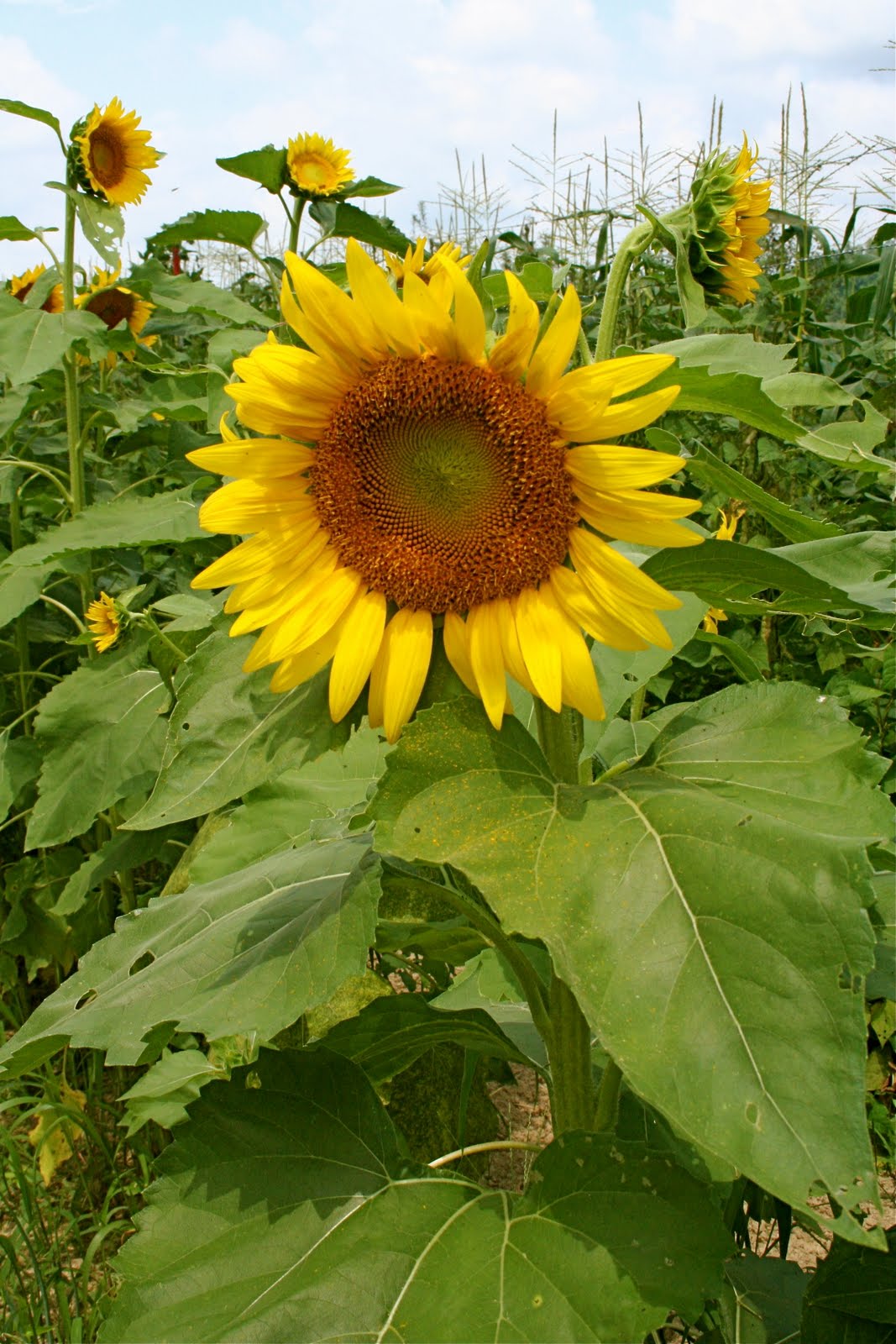
'The new country lay open before me: there were no fences in those days, and I could choose my own way over the grass uplands, trusting the pony to get me home again. Sometimes I followed the sunflower-bordered roads. Fuchs told me that the sunflowers were introduced into that country by the Mormons; that at the time of the persecution when they left Missouri and struck out into the wilderness to find a place where they could worship God in their own way, the members of the first exploring party, crossing the plains to Utah, scattered sunflower seeds as they went. The next summer, when the long trains of wagons came through, with all the women and children, they had a sunflower trail to follow. I believe that botanists do not confirm Jake's story but, insist that the sunflower was native to those plains. Nevertheless, that legend has stuck in my mind, and sunflower-bordered roads always seem to me the roads to freedom.'

~ Willa Cather, My Ántonia (1918) 


You come back when you're ready!

Catherine

July 18, 2011

Farmwife Monday

The winsome cover of Favorite Recipes for Country Kitchens.
The cookbook features many images throughout and great recipes.
One of my pastimes is trolling the internet for interesting images and collecting vintage cookbooks. When I was doing research for my book, The Pantry, a few years ago, I enjoyed searching the Library of Congress archive, and so many others, for pantry and kitchen images. Invariably they would include farmwives.

Monday on a farm or in a household was often known as "blue Monday" because this was traditionally the day that wash was done. Does it come from the "bluing" that was used or how women felt when they did their laundry? I'm not certain. I do know that my Old Order Mennonite friends do laundry with the old washtubs and wringers and I really don't feel I can complain. It's one of the chores I like to do, actually, but around here it gets done when it needs to.

So in honor of "Blue Monday" I want to inaugurate "Farmwife Monday" when I will (try to remember to) share different images that I have found here and there. Some of these may or may not be in the public domain so I like to give credit when I can.

Here is the entire image on the front and back cover.

This charming image graces the cover of Favorite Recipes for Country Kitchens, written in 1945 and published by General Foods (there is another similar version published in 1943 for Calumet). It is nostalgic for what many of us idealize about farm living: a well-coiffed, apron-clad mother ringing the dinner bell, in a white farmhouse––complete with picket fence––overlooking rolling hills, a well-kept valley farm and garden, and surrounded by a smiling family and farmhands. We know that farming is really hard work, dirty and sweaty but one can't help but be enamored with this kind of winsome image, even those who know the reality of farm life. I also like this image because I have some hollyhocks around my farm cottage and the rolling, open landscape is evocative of our own valley farm. [I also like that 1945 is the same year that my grandparents––along with my mother and her siblings––moved from New Jersey to a farm in New Hampshire. I have often written about that farm on my other blog, In the Pantry, and it will always be a source of happy memory and occasional pangs of nostalgic longing.]

A few months ago I came across the blog, Midlife Farmwife. It is written by Donna O'Shaughnessy who lives on an organic pork and beef farm in Illinois. I immediately contacted her because I felt badly for using a similar blog name, only in reverse. She was extremely kind about it, and most forgiving, and even gave me a nod. Since then I enjoy checking out her blog regularly. There are so many wonderful farm blogs out there and so little time! And so many farmwives of all kinds, on farms of all types or even those who have farm life in their soul somehow. The internet is such a blessing for connection in what can be an isolating life at times: it's like a modern day party line.

Thank you so much for visiting my blog and happy Monday!

You come back when you're ready!

Catherine

February 4, 2011

A Cookbook to be Excited About!

I admit it. I often get excited about cookbooks––new or old. But this one just screamed "buy me" and as I had been very good on Amazon for a very long while (except for Christmas gifts), I decided to purchase this one as a little cottage-warming present to myself. Even though I have yet to prepare anything from it, I am not disappointed.

I have this fantasy that one day we will rent a cottage on a farm in the Irish countryside and that I might attend some courses at Darina Allen's famed Ballymaloe Cookery School in County Cork. [Rachel Allen is Darina Allen's daughter-in-law and also teaches at the school.] My husband has Irish ancestry––and has been to Ireland many times. I lived in England for a year as a college student, and also on a high school exchange program, and can't believe I didn't get to Ireland!
"This transporting book ... will delight anyone who wants to connect with such endangered domestic tasks as churning butter, foraging, and making homemade apple cider. Allen is an astounding teacher, and her enthusiasm for good things and old-fashioned thriftiness is impossible to resist. She shares stories, recipes, tips, and techniques that will inspire you to craft all sorts of staples that these days usually come in packages from the grocery store. Once you taste your own vinegar and bread and cheese, and get into the swing of making them, chances are, you won't go back to the modern way." Fine Cooking, March 2010 

This cookbook covers so many things that I've thought about making or will want to make now that we are raising our own meats, with many eggs to use and an abundance of fresh items in summer months. There is a significant section on seafood, lamb, beef, pork, eggs, dairy, produce, fruits and baked goods. I found this book, initially, when trying to find a good soda bread recipe the other day. While there are portions of the books I won't be able to use in central Kentucky, most of it will be a regular resource. There are recipes for salting and curing meats, making sausage and preserving fruits. Also, a chapter on foraging for salad greens, berries and mushrooms, even seaweed! Allen is a big advocate of using local produce or what is grown, or raised, on or around your own farm. It is also a lovely compendium of great food writing and beautiful color photography.

A little armchair-travel-cookery-schooling can never hurt, either. The textbook-like cover is sturdy (it's a whopping 600 pages!). At anywhere from $26-40, depending on where you buy it, it's a lot cheaper than flying to Ireland and spending $13,000 on a 12-week cookery course. Well, at least that's how I justified another cookbook for my collection.

You come back when you're ready!

Catherine

January 5, 2011

The Fabulous Beekman Boys

We recently upgraded our cable package just so we could get Planet Green, and just so we could watch The Fabulous Beekman BoysI highly recommend that you do the same. If you don't have access to the channel, then you must at least read The Bucolic Plague––more about that in a minute––or get their first season on DVD.

After stuffing ourselves with Thanksgiving goodness, my husband and two boys and I watched every installment of the first season in a special marathon. We couldn't get enough and eagerly awaited their holiday special in early December. Josh Kilmer-Purcell and Dr. Brent Ridge seem to define 'gentleman farming' at first glance, but their antics and learning curve are enjoyable to watch. Besides, I'm rather partial to men who sometimes go to the barn in their tweed jackets, as my grandfather often did after church on Sundays. [He had been ascribed a 'gentleman farmer' when he retreated from the New Jersey suburbs with my grandmother, and their children, in 1945 to have a farm in New Hampshire. They eventually proved the natives wrong, as I'm sure Josh and Brent are doing.]

We were enchanted with Polka Spot, the diva guard llama who cares for Farmer John's beloved goats, and could relate to her antics (as we have a diva deer who comes and goes around our farm). Farmer John, who lives and works on the property, is also a devoted goatherd that truly loves his animals and isn't afraid to express that (even if that makes my less emotive husband uncomfortable).


Being the holidays and all, and a quick study in 'groupie,' I had to order a round of their Blaack raw goat/cow milk cheese (delicious), some goat milk soap, and a signed copy of Josh's book, The Bucolic Plague. Friends, this is one of the best back-to-the-land memoirs I've read or own (even better than Betty MacDonald's The Egg and I if you can imagine that, and an even match with Little Heathens by Mildred Armstrong Kalish). The kind of memoir I would probably write if I were an former drag queen dancer who left Manhattan for greener pastures with his doctor boyfriend. It is honest, fun to read, and you want Brent and Josh to succeed each step of the way.

While Josh still works in advertising during the week in Manhattan, Brent has been busy on the farm front––and from the looks of it, immediately successful––building up the Beekman brand. A stint with Martha Stewart certainly helped him there but he also seems to have an intrinsic methodology of marketing the farm, its products and their lifestyle. The show is another vehicle for this but it would be a hit whether they had "product"or not. I should also add that I technically bought the cheese, and the soap and the book to put under the tree for my husband. Well, not exactly. I suppose I was being both generous and extremely selfish at the same time.

If you haven't been to Sharon Springs, New York, where 'the boys' live and have their store, it's a lot like Brigadoon (or perhaps now that tense would be 'was like'). You can get there from the Canonjoharie exit on the New York Thruway, which I'd passed a zillion times over the years on the way back and forth from New England to Ohio without stopping (where the Beech-Nut factory looms and I always started asking my parents for gum). Or, on a more leisurely off-road and scenic jaunt along historic Route 20, which the thruway more or less bypassed in the 1950s, thus further cocooning the historic Victorian spa village.

At least that is how I remember it on our two visits there about ten years ago, when we stayed at the Adler Hotel (now abandoned) and met many survivors of the German death camps and Hassidic Jews who still 'took the waters' there. It was an experience out of time and place. Garth and Doug, regulars on the show, are how I remember them when they ran a café in the village: just as kind, fun and welcoming as they seem on the show. [They are now the proprietors of The American Hotel which they restored and opened in 2001––and where we likely would have stayed had it been open when we were there (although the Adler was truly unforgettable in its own way).]

But here's the underlying loveliness of The Fabulous Beekman Boys. In all of their squabbles and visions and hard work, they are just a normal couple. And this is the first reality show I can think of that portrays a gay couple just living their life like everyone else, even if it happens to be on a fabulous farm (and their grand Federal farmhouse is amazing) in scenic upstate New York. They are rural pioneers in a whole different sense than the typical 'urban flight to the farm' story.

In an age of intolerance, often in rural areas, this is also an empowering thing to share with children. There were only a few brief moments in the first season that made me wince a bit as a parent watching with children (we have a 13 and a 10 year old boy at home) but each one of them prompted discussion within our family about lifestyle and acceptance. Our children have always embraced our gay friends as much as we do and they are being raised to know that love does not discriminate. It was probably one of the best moments of the holidays for me.

For me, The Fabulous Beekman Boys is also the familiarity of a comfortable farmhouse, good friends who understand and support you, and historic architecture from my past lives, farm living, and great food (I am hoping there will be a cookbook in their future) that makes me want to watch again and again. And then there's Polka Spot––this llama is going to demand her own show if they don't watch out. The scene where she seems to play dead, with great effect, is some of the best animal footage I've seen on television.

I just can't say enough about the truly fabulous Beekman Boys, and Farmer John, and am grateful that they've shared their lives with the world and with my farm family on a quiet ridge in Kentucky.

You come back when you're ready!

Catherine