"Cows are my passion. What I have ever sighed for has been to retreat to a farm and live entirely surrounded by cows–and china." Charles Dickens
Showing posts with label Random Musings. Show all posts

April 11, 2017

"This is going to be some day..."


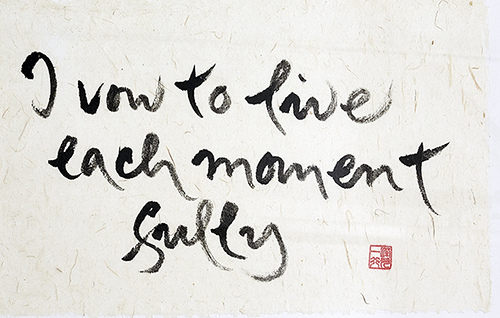
Much has been written about mindfulness and there are various books, blogs, and classes out there in the ether, and in reality. For some it is a daily practice and complete lifestyle. One of my favorite books is World Enough & Time by Christian McEwen (Bauhan Publishing) and certainly worth another read–I can't recommend it enough. A favorite blog is called "Zen Habits" published by Leo Babauta and I had to laugh when I read his recent entry, "Three Habits for the Overwhelmed, Stressed, Anxious" because that fairly well pegs it right now. Then there is anything written, or said, by Jon Kabat-Zinn (who happened to be the colleague of a family friend, who was also doula for my first child back in 1988, **Ferris Urbanowski. But that is another story...), and certainly Thich Nhat Hanh who composed the lovely Zen calligraphy that I've shared here (a small representation of his work).
Lately I've been struggling with accomplishing basic every day tasks and larger ones related to my writing and potential writing projects. Putting my health first is also a challenge and I've never been very good at "giving myself oxygen first." As I answer to no one, except myself or the flow of the day, this is harder than it might seem. While my time is generally my own––if not involved with making a meal, overseeing a medical issue for a family member that can be all encompassing (like right now), or taking kids to school and back––it would seem that I should have no excuse. I really don't because I can be my own worst enemy when it comes to time management. Even the 2-4 round trips to our boys' school (18 miles each way), which used to translate into 2-4 hours a day sometimes, have been removed because one of our boys is now driving his own car and his brother, too. You'd think with all of that extra time I've have MORE time but it just seems like it's falling through a sieve. [Bouts of depression do not help, either, but fortunately there are pills for that.]

I blame this fleeting time/time wasted phenomenon that I am now experiencing partly on my age and circumstances. A person in their mid-50s has easily lived more than half of their lives and there is no guarantee on the rest. The old adage about "it's all down hill from here," after one turns 50 is apt: after all, one accelerates as they go down hill, while trying not to trip or crash, and time certainly seems to be doing that, too.

I also have two very independent young men in the home–one of whom will be off to college in August and the other with two years still in high school. Yet I hardly see either one of them! Between school, and activities, and driving themselves now, and their after school jobs, it can be a revolving door and they don't need me so much. I'm on the edge of empty nest all over again having gone through it once before when my daughter stayed back in New England, at 20, when we moved here. Then another mini-bout of it in 2012 right before I turned 50 and when she lived here with us for about six months and then headed out west for a new job and new life.

It was Ferris, actually, who said to me something I have never forgotten. When my daughter was born, Ferris said, "She is no longer yours and the rest of your life will be a continued journey of 'letting go'..." That resonated then and even more so now. Empty nest is a real thing but so is each milestone of a child's life: eventually we let them go into the world, but every day when they leave the house we are letting go, too, and hoping that they will be alright. Then one day you wake up and realize they are almost grown, and gone.

The Persistence of Memory by Salvador Dali, 1931, MOMA
So there's that. Meanwhile, in my 20s, life seemed limitless and boundless and that I could do anything with it. At some point the reality creeps in that maybe you can't do everything you want, or wanted, to do. As someone with so many different interests, and an innate attention deficit issue, this can be cold comfort.

I have often written about my Old-Order Mennonite friend Anna who has been my primary glimpse into the world of a certain kind of mindfulness. She lives very much in the task–whether it be laundry (no electricity), baking, quilting, or gardening. Yes, she ponders but she primarily lives in her hands and is rarely idle–much like the Shaker saying of "Hands to work and Hearts to God." I get that but like so many things that I fully understand it is often the practical application that is the hardest. My mother is another person who always likes to be doing something–like gardening–and I have few memories of her actually sitting down except at the end of a long day. Both women are productive "do-ers" and it never ceases to amaze me that my mother worked on her feet five days a week as a nurse and then came home to care for three teenagers and her mother. And here I am, with no full-time job, fewer mothering tasks, and nothing but time all around me.

Well, that's enough pondering and "living in my head" for one day. Only so much we can do in the world (and what a world it is becoming) so it's always best to focus on the home front and what's right in front of me. Life is good and I am very blessed, despite the occasional glitch or hurdle (like getting in my own way).

Back to the spring cleaning! And it helps me to listen to a favorite album like "Big Science" (1982) by Laurie Anderson while doing so. One thing at a time, one moment at a time. It is all that we have.

"This is going to be some day...this is the time and this is the record of the time."


You come back when you're ready!

Catherine

PS I have often thought about **Ferris through the years and have not seen her for almost two decades. She was a big part of the lives of my family for many years as she worked with my mother, a former nurse, at Whole Health Center in Peterborough, NH where Ferris was a counselor. In the 1970s, not far from our family farm, Ferris built a small off-grid cabin in the woods along with a like-minded community of other cabin builders well before it was the trend. She drove a school bus while putting herself through graduate school and raising two daughters, one of whom went to school with one of my brothers. She even put in a good word for a great job in public relations at Antioch New England back in the day, where she had studied (yes, it is about talent but I've also discovered it can be about connections–which is probably one reason it has been so difficult for me to get non-writing jobs in Kentucky).

She was also right beside me, and my mother and former stepfather, when I had my daughter, all naturally, on a hot June day in 1988. Long before her work in counseling and mindfulness, Ferris was featured in the natural childbirth Lamaze work of Elizabeth Bing when she lived in New York in the 1960s. I knew she had struggled with a brain tumor in recent years and could no longer find her website when I looked last year. I just Googled and found this video that she posted last fall. I can't tell you how it means to hear her voice across the miles, to hear about her struggles and continued triumphs despite obstacles, and to realize how her words mean the world right now. I encourage you to listen, also, to the video below and you, too might find magic–and more mindfulness-in your life.

"May we come home to our hearts."


March 31, 2017

Spring Planting

A photograph from my latest article at RethinkRural
on "
How to Plan and Plant the Southern Spring Garden."


I can't wait to get out in the garden this year. The boys have spring break during the first week of April and, in between rain drops, I plan to get the broccoli starts in, peas planted, some radishes and beets, and maybe some other "cole crops" if there is room in my four galvanized steel garden beds (which are repurposed water tanks for cattle).

I also need to start some annuals that you can't easily get around here: some heirloom tomatoes (mostly those can be found in nurseries here in Kentucky but not my favorite, "San Marzano"); lots of unusual zinnias; and a few other unusual heirlooms.

There is also an adjacent garden shed nearby which needs a massive clean out and complete reorganization. I'm hoping to corral at least one of the boys to help, even if I have to bribe or pay them–they are so busy these days with school and after school jobs at a nearby farm that we've hardly seen them! Every time we do, they seem to have grown another inch.

Despite our warm winter and early spring–which has faltered a few times with numerous short cold spells–the garden still waits for me. This is our tenth spring in Kentucky and I look forward to it every year: it is prolonged, often warm but not too hot, a time when we can open windows and turn off the HVAC altogether until the real heat comes in mid-late May.

There is a succession of emergent wildflowers along the roadsides and fields. There are wild storms which bring literal excitement to the air (and I have had a lifelong storm obsession). In May we are rewarded with several weeks of local strawberries and my rhubarb is in full-on pie mode (the old timers didn't call it "pie plant" for nothing). Mid-May is also the end of the boys' school year here (which starts again in mid-August) so then it really starts to feel like summer.

[And there is always spring cleaning... It was supposed to take place in March, but as our oldest son is graduating from high school in mid-May and plans to have all of his friends here afterwards, and other family, it's time to get serious, folks!]

How will your garden grow?

You come back when you're ready!

Catherine

March 19, 2017

Two Women Sitting Around Talking (...and Listening)


The main reason I left Facebook recently is because so many people I have known (in person or as a "Friend") were at each other's throats, no matter their politics or persuasions. [As soon as Lent is over I will be back, but not much more than a few minutes a day and only for a quick check or a garden, farm, book, article, food-related post–and a vow never to post anything political there for the rest of my days!] Several acquaintances as far back from high school–and even a few here locally in the past few years–had also unfriended me because of our differences of opinion. That, as well as the negativity and constant political sharing, was my tipping point. I've always prided myself on having a wide swath of friends–on Facebook and in real life–who have different backgrounds, perspectives, religious views, and politics.

I am objective enough to see that there are impermeable bubbles on all sides and that so many of us have the need to be right, including myself. But perhaps what we really want is just to be heard? And that requires real time conversation, validation, or at least the lost art of listening.

Everyone has their thoughts on something and everyone has a right to them but then there is the whole fact vs. fiction thing and that, to me, is even more disturbing than disparate views on issues that affect us all. I don't want to make things political on my blog, either, but I will say this: we need to do more listening and less talking. And to do so with empathy and understanding and an objective mind. It starts within each of us. That is how I was raised: to enjoy a lively debate in the right forum or with others who are willing, but to not shove my beliefs on everyone else. But if you ask for my opinion or thoughts on anything, I am delighted to tell you.

This quiet, warm Sunday afternoon a strange man stopped at our door. I said "come on in!" because one of our boys said, "Oh Dad, that's the man you met at work." As soon as the man walked in and started speaking, I thought I was back in New Hampshire. His accent was spot on old-school Yankee: broad "ar"s as in "BAHN" (just the way my husband says it) and the kind of speech and cadence you don't hear much any more in New England unless you are on a back road or with an old farm family (both also increasingly rare).

Turns out he and his wife moved here last year for many of the same reasons we did: shorter/warmer winters, better cost of living, a different way of life, and a rural experience that is increasingly (and less affordably) difficult to find back in New Hampshire, or in much of New England for that matter.

So my husband and his friend went off to the shop and his wife and I spent time talking in the house over a cup of coffee. She was as politically interested and aware as I have been, and as engaged as I was on TV and other media until about a month or so ago. To be honest, I've enjoyed a welcome break from it all.

I was prepared to make small talk about New England and various places we'd lived or things we'd done or animals that we love (she trains horses). But she brought it all up first and, as she was a guest in our home, I was determined to be polite. Rather than spewing my own thoughts I listened to hers and only pushed back sometimes, and respectfully, just to make sure she knew I didn't agree with everything being said. Initially she seemed surprised but then she said, "You know, the only way to learn is from each other and the only way to do that is by listening." No truer words.

We had a real conversation without huffing or shaming or getting upset. Since living in Kentucky I have seen and heard other viewpoints and approaches to a wide variety of things. Because of that I knew the drums were beating loudly and consistently in the direction that they went in November 2016–at least from much of rural America. [But the pundits and pollsters were not interested in this reality, and neither were some of the politicians.]

All I will say now, before forever holding my peace on the subject, is that the conversation was very enlightening in both directions. She even said so. We are very different women from very different upbringings and perspectives and, like many people I've met or heard about, she voted for the first time in her life because she felt inspired to do so. Like others, she's been holding out for a hero.

We talked but we also listened to each other. We spoke of the great divide in the country right now but recognized that there was also some common ground between us–that we all as humans basically want the same things: a roof over our heads, the ability to work and earn a living, affordable healthcare, a safe(r) world.

In the old days people used to go around "visiting" on a Sunday afternoon. It was generally an open door "we're at home" policy. We have found that tradition exists here, too, especially among our Old Order Mennonite friends.


Real Time vs. Facebook Time is so much better, even if you don't agree or know each other well. Do we like having our opinions and ideas shared by people and friends who agree with us? Of course. But as long as we can talk with each other civilly about our differences, while also saying when something is wrong, I think we'll be alright. The rest is just noise, distraction, and diversion–even in much of the media. We just need to occasionally look up from our Smartphones and our computers, and our televisions, and have a real conversation.

You come back when you're ready!

Catherine

March 6, 2017

Unsocial Media

The title of this post is rather an oxymoron, I realize. But how "social" is media, really? Since I read it (and clipped it, and fortunately it's on line, too–so then why did I clip it, you ask? You'll have to talk to my inner hoarder...), this article by Andrew Sullivan has haunted me. "I Used to Be a Human Being," appeared as the cover story of September 16, 2016's New York Magazine. It is about what Sullivan calls "distraction sickness" and being bombarded by a constant stream of media, requests, emails, posts and commentary about every subject, as well as useless information. [Do I really need to know that Beyonce is having twins?]

Sullivan has a Smart Phone like most of the rest of the world. I do not. I have a cheap TracPhone that I load with more minutes every six months or so and I use it when on the road or in emergencies, or to text my kids when they're not here. I enjoy that part of it. I can't imagine having a more advanced phone near me 24/7 or the constant temptation to tune out–I was doing enough of that on my home computer, on Facebook, for the past eight years (since August 2008, in fact).


As you know we live on a farm. Stuff happens and phones are necessary. But I've never been able to justify a fancier phone and neither do I want one. If I had a job off-farm or traveled more than I do, perhaps I could justify having one (and yes, Instagram would be a blast but as it is I'm hardly on Pinterest–I enjoy it but it's not tactile enough for me: again, it's the recipe/article clipper hoarder in me). We got our oldest son, nineteen, an iPhone for Christmas on a basic plan. Three years ago my boys and husband each got an iPad (and my husband and other son, almost 17, each have a TracPhone, also). Since that time, with the iPads and the iPhone, everyone is in their devices on much of their down time. There is no letting the genie back into that bottle! So I am glad that we waited so long to computer-ize them (it was also my husband's first computer experience).

It's not that we're luddites (although you could argue that), it's that we're cautious. For a while I've seen how individually isolating this kind of thing is-even the home computer can be a kind of incubus for me. It is seductive, alluring, there all the time and where I can Google virtually anything in an instant and get way too many answers. I can send something to an editor in an instant, I can find many recipes for the same thing, I can spend hours just looking at different websites or searching and collecting things on eBay (that's another thing altogether). For someone with ADD, it is ironic that a computer can provide focus in its hypnotic capabilities. Sometimes I will be on the computer, whether writing, emailing, tweaking and organizing photographs, or, on Facebook, and I'm not even aware how much time has passed.

If I spent the same amount of time doing something productive (well, writing for pleasure, or money, is a form of production) that I spent on Facebook in a given day–without checking the time–I could probably move mountains (or at least laundry piles).

So for me, a Smart Phone has never been an option–not only am I "all thumbs," but I am used to keyboarding the old fashioned-way as I learned on a typewriter after twelve weeks of night classes that I took in high school (because I couldn't fit it in during the day). This summer, before he goes off to college, I will make my son do an on-line typing course, too. Invaluable. I type as fast as I think and, well, that can be a dangerous thing–especially on social media.

I'd reached the same saturation point that Sullivan spoke about, about two weeks ago. In the post-election and inauguration I was saturated by negativity and opinions from all sides and still continuing to give my own. It was a no-win and it was draining. I realize that some people need to vent and need to organize or whatever else they need to do. But for me it was keeping me away from more important things-like my own work, or ideas, or just doing different things with my day.

Obama was our first social media president in that most people over 40 joined Facebook during his presidency (he, too, used social media effectively and positively to help win his elections). During this time, the kids moved on to other social outlets and Facebook became hijacked by adults. For the first time in our lives everyone had a public voice, a forum, and a place to vent and share information about their opinions in an immediate way. I believe this also gave strength to false or alternative facts. We stopped fact-checking or thinking for ourselves and everyone, no matter what their political inclinations, seems locked in their own impermeable bubbles. And it can be exhausting if you let yourself go beyond family photos and sharing recipes or silly Youtube videos.

I've been off of Facebook for almost a week. I honestly don't miss it. I do miss some of my Friends there but they know where to find me (and I do enjoy keeping in touch with old friends who wouldn't otherwise write or even be in touch). I have to say that Facebook is an invaluable resource and I will likely return again, but more sporadically and then for just a quick check-in or post about something on the farm or when I've had an article out.

What have I done to fill that void? Well, I've started blogging again, and walking again. I have a better flow of thoughts and ideas–it's like a valve has been turned back on. There is less "mind clutter" bombarding me throughout the day and it's already cluttered enough.

I've also been writing with a new kind of energy because I'm not putting that same energy into trying to be right on Facebook or to prove a point. The fact is, no one is listening. No one cares. In person, they might but not when you are pontificating or ranting. People shut down, sometimes even if they agree with you. And if you are singing to the choir, wouldn't you rather save that energy for singing with them?

I have many bad habits but this one required my immediate attention. So far, it's working.

Now, about those "Real Housewives"...

You come back when you're ready! 

Catherine

August 25, 2015

Keeping a Journal

The other day I bought a crisp new notebook. It looks like a basic composition notebook with the cardboard covers but it is new and thick and full of lined white spaces. Its pattern is decidedly herringbone.

I used to write in a journal almost daily from when I moved to Boston, thirty years ago this month, in fact, and through the first few years of my daughter's life––a period of five years. There were some years in high school where I made an effort and I was also dutiful on an exchange program to England when I was 16, and again on my junior year abroad (back to England). I also kept a haphazard journal during the first year of each of my boy's lives, too. And then email came along, and blogging soon after. So journaling seemed to dissolve away (plus, I type much faster than I write).

I have kept each of these journals and intend to revisit them this winter. It occurs to me, like the script writing of my great-grandmother in her turn-of-the-twentieth century journals (which I am (slowly) transcribing), that my children will have difficulty translating them one day. So I intend to transcribe my own one day––perhaps with a bit of editorial license, perhaps not.

My first official journal exercise was when, after camp for two weeks in 1973, my grandmother said that if I wrote up an essay about my experiences, she would buy me a flower-power notebook set. It was from Mead and I very much coveted it at the local five-and-dime. Perhaps it was that exercise that helped set my experiences there into the concrete of memory. It was a pivotal summer in my life and I had not wanted to go to camp or stay: I got very homesick. My parents had separated only a month before and my paternal grandmother died during my second week. So I actually left for a day for her memorial service and burial, and came back to finish my last few days at camp. It was that summer on our annual August visit to New Hampshire, where we would move with my mother the following year, that my grandmother encouraged my journaling. Just as she had encouraged my letter writing since the second grade.

A few years later, my writer friend Elizabeth Yates McGreal gave me a beautiful red desk diary for 1976 with a page a day. I wrote in it almost daily and often enclosed snippets and longer lists of things I wanted to include that were happening at the time. We read together every Tuesday afternoon, with tea in the comfortable parlor of her old New England Cape Cod house, and she encouraged my emergent love of all things English. This beautiful diary was from Smythson on Bond Street in London. It had been given to her but she passed it along to me with the proviso that I write in it. And so I did.

Some of my favorite writings to read have been journals (and letters, too): Sylvia Plath's (although heavily edited) and Virginia Woolf's come to mind. Willa Cather's letters, which she never did want published (she had requested of her friends that they burn her correspondence to them upon her death––most complied).

I've been blogging for 10 years, its own kind of public combo of journaling and scrap-booking. I did try journaling in a Word document but it's just not the same thing: I want to edit it, as I have reedited this blog post already several times now! But I have missed that pen-to-paper feeling of recording thoughts onto something that can be read without turning on a screen, not editing for an audience, and just getting it all out, whatever "it" is.

I've always found that when I journal, or even when I record a few lines in the 10+ year journal that I got a few years back (and with which I have not been faithful, either), that life seems to go a bit more smoothly. Perhaps because when you journal you are folding and creasing the various bits of your life into something cleaner in the expression––maybe even something that needed washing out with a good starching and ironing. I find that I can remember time and events a bit more clearly, too, when I write about them in some kind of progressive order. "Ah, that happened." In perusing my own journals I can be transported back to that very day in my life.

Written words in a journal take on their own unedited crispness if you allow them to––it takes practice but write what you need and the rest will follow. Write the sacred and profane, write the everyday or the philosophical. Stop or start as necessary. Don't worry about proper form (but paragraphs are good). Just make it your own refuge and a place to harbor "the bits and threads of your very life," to paraphrase Katherine Mansfield.

We'll see what these new pages bring.

You come back when you're ready!

Catherine

August 22, 2015

Feeling Fall-ish

It's been so long since I've blogged that I honestly forgot my access password (good thing for "Stickies" as I'd recorded it there).

This past year has been a flurry and now that fall is approaching––my favorite time in Kentucky––and the schedule is more organized, the weather is cooling, and I'm in the midst of fall cleaning, well, I just feel like blogging again a bit more often.

And can I just say here that I've been scouring local places for pumpkins-–since early August? It's the back-to-school thing: our boys went back to school on August 6th this year and it immediately propels me into a fall-mode of thinking. Bring on the pumpkin spice!

In my five years of job-searching, 2014 was the first push towards something. I had two interviews at a place in Lexington, which turned out to be not a good fit so it was just as well I was not tapped, and another more locally, from which I withdrew (and thankfully with good instincts -- ALWAYS trust your gut!).

In January, I got a call from the local county paper where I'd also applied months before (and had forgotten all about), and they wanted me to freelance for their newspaper on occasion and for their insert magazines. It's been a fun, part-time job and in the past eight months I've gotten to know much more about the place where we live. [I wish I could link directly to some of my articles but their website does not archive them.]

In June a lovely woman emailed me from Rethink:Rural, a startup blog on rural living that she is editing among other duties for a real estate corporation based in Florida. She wanted me to contribute every month or so, with my own photography, too. I am delighted with this arrangement (and yes, the income). Here are two recent posts:

Mennonites & Me
The Thousand Mile Journey to Start a Farm at Midlife

Last month I applied for a dream job in nonprofit world -- I pitched the idea as a telecommute with part-time on the ground. They were very interested but hired someone who could be there full time and I entirely understand. The good news is that they want to do some public relations consulting and that in 3-5 years time this could lead to something full-time. By that time our boys will both be in college. It is a job that combines all of my loves and vocational interests: writing, historic preservation, local heritage tourism, public relations, rural life, and perhaps the greatest American writer. Ever.

Life is always interesting. My advice in a nutshell is keep plugging, keep sending things out, applying, or pursuing your dreams. They will happen. Hard work + opportunity + luck all co-mingle at some point.

Or, as Thomas Jefferson said,

"I find that the harder I work, the more luck I seem to have."

In the meantime, life on the farm is always busy. I promise to blog more often.

You come back when you're ready!

Catherine

April 21, 2015

Celebrating 10 Years of Blogging!

Illustration © Hillary Knight
Mrs. Piggle-Wiggle by Betty MacDonald
Today, April 21st, 2015 is the 10th anniversary of my In the Pantry blog and of my blogging anything at all, in fact. I don't post regularly there any more but there will be many changes taking place over here at "Farmwife at Midlife" regarding related writing, blogs, and other exciting things to share. I'll be detailing everything in the coming weeks.

A bit of necessary "housekeeping" and tidying-up. Then I plan to write here more regularly again. It's been a busy nine months since I last posted.

The Pantry-Its History and Modern Uses is still available from my website. I will continue to post pantry-related updates as I can as pantries will always be in our lives.

My very best wishes and thanks for your readership over the years.

–You come back when you're ready! 

 Catherine

July 29, 2014

Farmwifery – An Update


I originally wrote this piece in January 2011 when I was just starting the blog. It needed a bit of updating, so here goes: [in RED] My family was also recently featured in a "Huffington Post" article on our journey from New Hampshire to our Kentucky ridge farm. The piece tells a bit more about our story.

Farming is not something out of the pages of a magazine, although old stuff and a big country kitchen helps. A lot. Here are some of the things I've learned so far in the past few years on our farm:
  • On a farm nothing happens overnight, except for frost (or a newborn animal).
  • When it first frosts, Johnson grass produces cyanide so you can't let your cows near it for at least 24-hours. Fortunately, a nice neighbor told us this.
  • Doublewides are not (technically) trailers, but they're not real houses, either. [But the local water department and everyone else calls them trailers.]
  • Young fawns are all too easily maimed or killed by haying equipment. Soft-hearted, but insane, farmers care for injured deer, much to their joy and, sometimes, sorrow.
  • Free-range chickens are adorable, until they poop all over your porch.
  • When a neighbor says 'you be careful!' as you're leaving, they're not cautioning you about a hillbilly hit. It's a nice, friendly form of 'goodbye.' [But 'you come back when you're ready' is really less obtuse.]
  • Clean cattle tanks make excellent places for a good cool bathe in a pinch. [Click here: view #11]
  • Robert Frost was right: Good fences do make good neighbors. But he didn't say anything about when those fences are moved without permission or boundary lines are altered on maps.
  • If you throw on an apron when someone is coming to the door, it goes very far towards tidying up.
  • If you wear an apron around the farm, you don't have to wear a bra.
  • Biscuits and sausage gravy make the best breakfast––and easy to make (the biscuits and the gravy, both). I can't believe it took me 45 years to even learn of this combination!
  • Supper at 10pm is not uncommon during hay season when every ounce of daylight is utilized. [And fortunately, this is my more 'manic' time of year.]
  • Boys love tractors. So do their fathers. [But on our farm I am only allowed to drive a riding lawnmower. There is good, but arguable, precedent for this.]
  • A mud room is a must-have on a farm, ideally with a shower, or at least a nearby fire hose.
  • The sound of absolute silence is absolutely lovely.
  • It's great to have neighbors, but it's even nicer when they can't see you.
  • If I didn't have satellite internet I could probably not be a farmwife. On a quiet ridge. In Kentucky...that is, until lightning strikes and knocks it out (August 2012) and you are promised DSL "soon." [As of May 2014 we now have DSL!]
  • Do not name your animals if you intend to sell them or eat them.
  • Learn how to put up a lot of your own food––canning or freezing––and buy a generator.
  • Beware the reality that you might be conflicted about raising animals, caring for them, and then selling or eating them.
  • Do not expect to make a regular pay check farming––or freelance writing.
  • Learn to roll with the punches, the losses, the sorrow, the weather, the fickle income, or you won't make it as a farmer (or for that matter, most weather aside, as a freelance writer).
  • When you see a rainbow or a newborn calf, the barn is full of hay, or cool breezes are blowing, say "AH!" and be glad: there might be a windstorm or drought another day, or a sickly cow.
  • Enjoy the moment, plan for the future, but do not look back...EXCEPT when a bull is in your vicinity.
You come back when you're ready!

Catherine

October 28, 2013

Ode to Dad


My Dad, James H. Seiberling, and me on my
Grandpa Sei's croquet court in Akron, Ohio, c. 1976-78.
My father has been gone eleven years. Yesterday I was listening to some classical music on NPR that I know he would have enjoyed. For a long time I couldn't listen to any classical or nineteenth century music, or anything on the organ, without weeping. For my father, music was his lifeblood, his passion, his heartbeat. I am fortunate that he passed that along to me in a diffused but enthusiastic measure.

As I was listening to some child prodigies playing Brahms and other works while at the table in our quiet kitchen on a Sunday evening I was also rummaging through some old recipe clippings. I found them in the shed in one of many unopened, and as yet unplaced, boxes that have formed the detritus––and delights––of my middle-aged life. There, from Dad's college typewriter (he never did try to use a computer), was a recipe he had brought to us in an early autumn of our marriage, on one of many visits he made to New Hampshire to see us each year. I thought of Dad, of course, while reading it, and smiled at a frugal notation he made (see below) and thought, given the season, that I should make it again. Then I realized that October 27, Sunday, was the actual anniversary (and same day of the week) of his passing eleven years ago. This is usually a date that I would have anticipated weeks ago but I suppose it is a sign that the immediacy of grief has slowly left me, replaced only by the presence of my father in my soul and memory as I navigate through the rest of my time here.

Dad died just two days before my 40th birthday and at the very minute, at 2am, that the clocks turned back in the hospital for Daylight Savings time. My two brothers and I were with him for his last days which was a blessing and a comfort and we had all been in and out in the few months prior. Dad's doctor said at the time, "I called and you all came. Not everyone does that, you know." There were many profound and unexplainable things that happened during his last day, and at his memorial service a week later, and I've written about them privately. I always found the Daylight Savings timing to be a strange kismet as he welcomed the darker days of winter when he could be indoors and hibernate as he was want to do with his music and his television. It's not that he was antisocial––being out and about was just always on his terms, like so many things.

As well as music and playing the organ, Dad loved all things autumnal, like I do. He liked Halloween and unpasteurized apple cider (from an old mill in Loyal Oaks near Norton), pumpkin pie and apple crisp and he especially liked homemade apple butter stirred into large-curd cottage cheese. He sometimes joined us for Thanksgiving and appreciated my stuffing (there were several dishes that he liked me to make when he visited but he always preferred his friend Alice's potato salad to mine!). He liked the cooler days and the thrill of the baseball playoffs and World Series, no matter who was playing. Of course, he was a born and bred Cleveland Indians fan and even though I could care less for the sport, I enjoyed going to home games and feeling the breeze from Lake Erie and being a part of the roar of the crowd and sharing this great American tradition with my father and brothers and cousins. [We would also meet my cousins each summer in Boston at Fenway Park––usually for an Indians-Red Sox game.]

The year he brought me this recipe, for Jacobs Field Apple Crisp (once served at the home of the Cleveland Indians and now called Progressive Stadium), he also sat in our darkened kitchen and played spooky music on our daughter Addie's electric organ while trick-or-treaters came to our porch. Hancock was the perfect small village for door-to-door goblins and we must have had several hundred children each year from the village and surrounding towns. Dad delighted in seeing the costumes and our decorations and enjoyed many meals around the same table that now graces our small Kentucky kitchen. There he was comfortable telling us stories of his childhood and so many memories that he'd never shared with me before. Perhaps it is something about a kitchen table and a good meal that evokes such spirited remembrance.

So yesterday I was able to listen to beautifully played music, all of which my father would have known by composer, title, and movement. I savored a favorite recipe in his typewritten hand and I was grateful. I know he is still with me, every day, and I know we will be together again. And I know that he is in the great celestial realm, somewhere, playing the organ and singing in a choir. When I hear music that he once shared with me, it is a kind of connection to the divine. And that is why I have always sung, too. After all, singing is like praying twice.

Of course, I plan on making this recipe again very soon. Here it is written exactly as he typed it (if I had my scanner set up I would just scan it!):

Jacobs Field Apple Crisp

Filling:
  • 15 apples (4.5 pounds) such as Macs or Golden Delicious
  • 1 cup brown sugar packed down
  • 1.5 tsps ground cinnamon
  • 1/4 tsp ground nutmeg
  • 1/4 tsp ground cloves
  • 1/4 tsp ground allspice
  • 1/2 cup cider or apple juice
  • 1 Tbsp. cornstarch dissolved in 2 Tbsp. water
NOTE: Allspice and cloves may be omitted if not already in your spice rack as they are quite expensive today! [Dad was a bank branch manager and always frugal and I appreciated his concern about my spice cupboard and finances.]

Crumble Topping:
  • 1 cup flour
  • 1 cup brown sugar packed down
  • 4 cups granola cereal [CSP note: I've also used plain rolled oats.]
  • 2 tsp. cinnamon
  • 1/8 tsp. nutmeg
  • 1/8 tsp. allspice
  • 1/8 tsp. cloves
  • 3 sticks butter, melted
For the filling: Peel, core and slice apples. Combine apples, sugar, spices and cider in large pan or wide kettle. Simmer uncovered over medium heat until apples are tender, about 15 to 20 minutes. Be careful not to burn. Stir in cornstarch mixture. Simmer several minutes, stirring occasionally until thickened. Remove from heat.

For the topping: Combine flour, sugar, granola and spices in a bowl. Add melted butter and stir until dry ingredients are thoroughly coated. 

Place filling in a baking dish and heap the crumble topping over the filling. Bake at 325 degrees for 15 minutes or until golden and bubbly. [CSP note: I've not made this in a while so baking time might be longer.] Let cool and serve with ice cream or whipped cream.

Recipe can be halved for smaller amount.

He added: "This is awesomely delicious. I know you'll enjoy!"

Happy Halloween to you all ~

You come back when you're ready!

Catherine

September 7, 2013

Country Auctions & Other Musings

My son Eli at the Highway 127 Yard Sale in 2009. We love to "troll" together.
Today I went to a country auction in King's Mountain, Kentucky and didn't spend a dime. But it was worth going just to see everything, to observe the (rather small) crowd, and to head off ridge by myself to do errands, have lunch and borrow some free WiFi. The highlight for me was hearing our Old Order Mennonite friend Paul doing the auction and holding up a pseudo-bronze wall plaque. "It's of some people having supper!" There were a few chuckles from the crowd as it was a bad copy of Leonardo DaVinci's "Last Supper"––you have to really appreciate the lack of worldliness in their culture, especially in the crazy, instant world we live in today. It made me smile.

There were other things, too, but nothing I absolutely needed. One intriguing lot was a grouping of old photographs of people in the mid-late 19th century. I asked the former owner's daughter if she knew who they were. "No, they were relatives of my step-grandmother." The photos were marked with a Louisville, Kentucky studio and the groupings were typical of the period. It always makes me sad when I see old photographs of people in antique shops or at auction. They are the last vestiges of a life and when someone casts them away it usually means they are no longer remembered or known by any living person.

On Labor Day we were invited to a picnic on the ridge—a time of year that people often have family reunions down here. There is a saying in the South that I have found quite true: "God, Guns & Ground." To that I would add "Clan" as family is as important as church here and usually families stay together or at least nearby in Kentucky (and it's a given that almost everyone is related to someone in a small region or on a ridge so you always have to be mindful of that!). Two daughters and their families, and their younger brother—just married—and his new wife, all live on adjacent parcels of the original “homeplace” where their parents still farm. So there they are, altogether: family and neighbors through thick and thin, and they even garden together. It made me sad because that is what we always wanted for our (former) family farm in New England. It was great to be included in their gathering but there was this persistent longing for what will never be in my own family of origin—two (nuclear) parents and their children, and spouses and grandchildren, all gathered around. I hope, at least, to create that kind of matriarchy for my own family while honoring my ancestors with them. It is the least I can do—but also the most I can do—for my own clan. I never want to preside over a fractured matriarchy and neither will I ever allow my children to be separate from each other: I will get them home to sort things out if there is any discord between them. Period. And if I should ever be widowed, there is no way in hell that I will ever let another man come between me and my time with my children and grandchildren. PERIOD!

I do miss blogging but it is so difficult and slow on my ancient (c. 2004-imagine!) MacPowerBook G4. DSL still eludes us on the ridge and the boxes, installed in October 2012, are covered in weeds. I'm ready to get a "HotBox" through Verizon or some such and looking into options. I haven't had my trusty camera with me for some time as I have a bad lens that needs repair or replacement (and I've also enjoyed taking a break from taking photographs of everything of interest). In the meantime I'm hashing out a contract with a publisher for another book deal. I'll keep you posted and it relates, in some way, to pantries and kitchens and all things retro.

Fall is coming. I love the change of light, the cooler nights and mornings, the beautiful pageant of yellow, purple and mauve along the roadside––and here in rural Kentucky the smell of leaves burning around the ridge! After April and May, I do believe that September and October are my favorite months on the farm. The boys and my husband are gathering in the large round bales from our third cutting of hay as I write this.

I'm also canning up a storm (Stanley plums a few weeks ago, Kentucky white peaches for the freezer, and beets for the freezer are up next) and hoping to get in my fall garden––broccoli and Brussels sprout starts, and beet/lettuce seeds––over the weekend (but it's been so hot during the day that I fear bolting).

I hope to be doing a bit of off-ridge traveling in the next few months before the winter ahead. The almanac is talking about a colder winter for Kentucky. I wouldn't mind: nice, cozy, good for writing and reading, and full freezers and pantries to raid.

You come back when you're ready!

Catherine

June 14, 2013

"Just Sit at Your Desk and Write"

A Lady Writing, Johannes Vermeer, c. 1665
National Gallery of Art, Washington, DC
This is what my husband always says before––and after––I've applied for each of the thirteen jobs for which I've been well qualified––with no interview (not one).

"Just sit at your desk and write." 

Even though there is laundry. Even though there are meals to prepare. Even though there are happy boys haying and swimming and tracking in endless piles of farm dirt. Even though the house is always generally a mess. Even though we are moving, at last, into our farm cottage in the busy middle of our farm, from a more commodious, but stifling, doublewide across the road.

So yes, there is still the "stuff" and there is the refiguring of the boxes and the storage issues as we await our once and future farmhouse.

There is still no DSL (which is why I do not blog as much as I would like to do).

But there is a desk. There are many pens. There is much paper. There are computers. There are summer breezes sailing over the knob even on the hottest days and into our farm cottage. There are cattle lowing and birds chattering. There is bountiful broccoli and other emergent plants. There are full pantries and freezers.

And there are words––always the words.

"Just write," he says, partly from exasperation––perhaps because he knows me better than I do myself. Or maybe he is just weary of being a cow-man with a perimenopausal, somewhat haphazard, farmwife.

"We are a team. Just write."

And so I shall.

You come back when you're ready! 

Catherine

April 23, 2013

Random Acts of Violence


Menacing storm clouds over our ridge farm last spring.
On Monday, April 15th, after a late afternoon at the library helping my eldest son gather research for his World War II project, we came home to our ridge. As we drove down our farm lane, I shared my benediction with my son as I noticed the fringes of redbud along the greening forest and our cattle grazing on pasture after a prolonged winter. Each time I come over the rise and dip of our knob and behold the picturesque meld of landscape that defines our farm, I am grateful. No matter what has happened in my day, I feel nestled, even safe, in the sustenance that is our homeplace.

My husband greeted us at the door. “Have you heard about Boston?” I had not even checked Facebook at the library, as involved as we were in our short research of the enormity of World War II. “Bombs went off near Copley Plaza at the end of the marathon.” Without knowing anything more, I felt sick. Boston is a city where we are both familiar, where I once lived, worked and went to graduate school, and where my husband was planning to be this week for an annual club dinner (he did not attend, after all, but had a lovely visit with many old friends in the area). We moved to Kentucky five years ago but we will always be New Englanders at heart.

Before I could process the Boston Marathon horror, my husband came closer so our boys would be out of earshot. “I picked up some trash on the side of the road and got pricked by a hypodermic needle,” he said. I went into my usual mode of rapid-fire questioning when presented with something jarring. Yes, he’d called the doctor and made an appointment for a blood test the next morning. No, he’d burned the evidence in the stove, left in its Hardee’s bag, after a fit of anger and so no one else could be harmed. We called a neighbor, not telling her why, to ask if she’d seen any vehicles drive past when we were both off the ridge to get our boys from school. Any vehicle driving past our farm is cause for a pause and a wave. No one lives on the county road but us so it isn’t especially well traveled—however, it is a short-cut connector between our larger ridge road if you don’t mind the bumps.

I saw my husband and our youngest son as I passed and waved to them at an intersection before they headed home. I remember thinking, with their arms outstretched towards me from their car windows, “They look so joyful!” They came back to the ridge before we did, a few hours later. My husband notices details and stopped to pick up the Hardee’s bag. The constancy of trash along the roadside, or dumped wholesale down a gully, is a sad occurrence in parts of Kentucky where there often seems to be little regard for the land or its intrinsic beauty by the people who were raised in these hills. This is not a judgment call, just fact: just as many seem to disregard their pets by not spaying and neutering them and allowing them to roam and become other people’s problems.

My husband has built a working cattle operation in the past few years from run out farmland and he works very hard. Even though we struggle at times, we don’t even take the farm subsidies that are available to us through the Farm Bill because we regard it as unnecessary welfare. [“Send it back to Washington to pay down the deficit!” my husband said when our local agency said it was there for us. “That’s not how it works,” was the reply. Just imagine the logic, for a moment, of being paid to not grow something?] I admire someone who, in his 50s, has the conviction that this is what we should be doing with the rest of our lives. Neither does he hesitate to pick up trash, barehanded, on our barely-traveled farm road where it always seems such a deliberate violation.

My first thought regarding the needle prick was that he has health insurance (I was denied). My second thought was more selfish and entirely mother-driven: “thank goodness it wasn’t one of the boys.” My final thought was “what if?” I didn’t linger long with that question. In my upset over the needle incident and its possible outcome, as I watched the coverage of the tragic Boston bombing, I realized there is no predicting the senseless events that occur in our world. Neither is any place safe or immune from the possibility of tragedy, whether natural or triggered by human interaction. There is a strange calm in this knowledge. My anxieties do not revel in the things I can’t control but in the things that I can.

I winced at the irony of receiving a “service message” phone call as I wrote this: “The FBI says there is a home invasion every fifteen seconds,” it began. “If you allow us to install a new security system…” at which point I hung up the phone. If bombs can burst and kill and maim in a crowded city street in America, or a troubled person can enter a suburban school with a semi-automatic weapon, then a tossed and dirty needle can pierce a hardworking man’s hand on his own peaceful bit of farmland. No one is exempt from being violated and, like everyone, my family has had its share of harmful acts from external sources. Yet we can never allow ourselves to be defined by our misfortunes or the difficult things that happen to us along the way: victims always wallow in the mire and blame while victors rise and move forward from the wreckage.

Even if we are able to find the person who used and threw away the needle, the damage may have already been done. So now the question is do we live in disgust or fear of every bit of “trash” or person who wishes to do harm or do we listen and look for those moments of quiet beauty, as when the whippoorwill calls across our fields at the edge of twilight? Or when neighbors let us know that they saw one of our cows struggling to give birth and then offer to help our boys while their father is away? [But I do need to boast for a moment: by the time the neighbors arrived, our boys had corralled the mother and pulled its calf safely and with all the finesse of seasoned midwives.]

I had to cheer what David Ortiz said at the Red Sox game on Sunday: “This is our f@#$ing city!” This is our f-ing country, too. I don’t often say this, and at the risk of sounding jingoistic: “Love it or leave it.” At least respect, nurture and honor it. Don’t trash it. Please don’t deny that we have major environmental or societal problems and accept that our own small orb in this immense universe is in trouble—and, God willing, or not, we can affect the outcome of our planet and how we interact.

My heart is with the families who have suffered loss of life or massive injury in last week’s bombing and as a mother I also feel for the family of the brothers in the Boston tragedy. At nineteen, the youngest brother is only four years older than my oldest boy. Where was his mother or his father for the past few years? Even though he seemed Americanized and had even become a citizen, did he feel alone and homeless? Without home or country? Feeling displaced, or without place, are disconcerting places to be—sometimes with no firm or familiar ground. We may never know what drove these young men, or other people, to hurt innocents in the name of a cause or personal hurt. What causes someone to explode rather than to quietly implode? I will never understand a religious faction that advocates killing or hatred—and, throughout its long history, Christianity, as a religion (not the person in whose name it exists), has not been immune to this, either.

While we live on an inconsiderate planet, where people, animals—and the land—seem increasingly disrespected, I still know there are those who run back into the fray to help or who stop to assist a stranger, to take in a stray animal, or who are willing to share their time or what they have with their neighbors. When there are random acts of violence and terrorism—as there have been throughout our world’s history—we must also assure that we never lose our humanity and hope for goodness. If we do, those who terrorize, or who bully or disregard the rest of us, will have won.

Each spring, violets bloom from the detritus of fall––always a reassuring sight in a weary world.


“Love thy neighbor as thyself.” If we could just remember this basic creed and put it into more regular practice, whatever our religion (and it is a tenet of all faiths), the world would just be better. Practice random acts of kindness—daily, even hourly—in quiet benediction or loudly to the hills or the city canyons. And pray—pray especially hard for those who wish to harm us or through their own sad lives, can’t seem to help it (whether from their hatred, envy, greed, ignorance or inadequacies). Sometimes, in a crazy world, it is all that we can do.

You come back when you're ready! 

Catherine

January 23, 2013

National Pie Day


Pie (and cake) being served in Pie Town, New Mexico, c. 1940s, Russell Lee (for Works Progress Administration)


I couldn't very well let this day pass without notice, even if I am not making any pie in its honor. The last day I wrote about National Pie Day was just after Obama's first inauguration in 2009 (on my dormant blog, In the Pantry: just go there and do a "Search" on anything related to "pie" and "bakery" and you will find many writings). Then I was going to write about the many wonderful things I learned from Robert the Baker in the ten years I worked for him––but that will become its own sort of essay (and many years ago, probably about seven or eight, I wrote about him, too). And this is a blog, after all.

I'm celebrating National Pie Day this year with two healthy fruit smoothies and some homemade soup. My husband and I are doing the 21-day Digest Diet to get ourselves on track and to boost some needed weight loss. So no pie for the Ponds right now. I'm not ruling it out in the future but, well, let's just say that I like this "diet" because it clearly tells me what to prepare each day in an easy-to-follow format and I'm too busy right now to worry about meals. If someone is telling me what to prepare, and it is easy to do (sort of like spa cuisine), that's half the battle. If we can get through the more restrictive first four days, we can do anything. I'll let you know how it goes.

For now, I am enjoying a lot of food porn: in cookbooks, recipe clippings and favorite cooking shows. It really does help.

You come back when you're ready!

Catherine

For more about Pie Town, New Mexico, here is a great online article in the Smithsonian.

September 24, 2012

Do Not Name Your Livestock if You Will Kill Them

"Big Red," front and almost center, in a recent photo of Eli for a project he did on oak trees for school.

Let me tell you about Big Red. He was a handsome steer, filled out, solid, sweet and kind. Last summer one of our boys had named him and, over the past few months, I had grown fond of him, too. He was among the cows we were keeping, because they will make fine bulls, like Edgar (whom I named after my husband brought him––cold, muddy and abandoned––from the knob pasture after Christmas), or "39" (because of her ear tag), Tess or Angel Clare who are all, or will be, great heifers. "39" will even let us pat her and come up to her in the pastures. These traits are good in cattle, especially if you are developing your own herd. You don't want a cow that is skittish or fearful or who might charge you, unprovoked, in the pasture. You also don't want a cow that will all too easily abandon its calf. Turns out, there are great mothers in the bovine world just as there are really lousy ones. You can never trust a bull entirely but if you have a gentle heifer or steer and continue to treat them well, you can maintain a kind of trust.

Big Red developed into a 968 pound beef cow in the past year just as his temperament was unusually kind and friendly for a pastured cow. There is no saying what kind of bull he would have made but I expect, as with Edgar, that he would have been fairly mellow. At first Big Red was being raised for our own freezer but then I got involved, and attached, and, well, to be honest, we all did. He was such a presence, even ham-like for photographs.

Last month a beef buyer was on the property and made a comment that Big Red would fetch a good price at market. We went back and forth as a family and last week my husband broached the idea again. I said, no matter what, I can not put him in the freezer and transform him into our simple farm cuisine. 

"Well, let's let the boys decide, they have raised and named him," I suggested, not willing to decide myself. So my husband did. 

While I was away at a few days respite and the Kentucky Women Writers' Conference in Lexington, I got the phone call.

"We put Big Red on a truck today."

I was digesting a lovely meal and about to see (what would be an unsettling few hours of cinema) The Master at the Lexington Theater with our daughter. The irony was not lost on me.

As the hours, and movie, went on I could not stop thinking about Big Red. What was he thinking? How was Edgar taking this? Why can't we keep them all?

Tess and Angel Clare, a female calf born on the Summer Solstice in 2012,
both have stays of execution on our farm because they can reproduce––and, I named them.

As our oldest son Henry said, with rhetoric and wisdom beyond his years, "Are we operating a cattle farm or a 'friendly' farm, Dad?" He has a point. We can not keep all of the animals that we raise and we clearly can not name them or pet them all, either. No wonder kobe beef is so expensive: all of that personalized pampering and attention.

Back at the hotel, I called my husband, now even more troubled by a strange and haunting, excellent, movie. I asked if he could reconsider Big Red's fate, knowing it was too late. You can't really buy back your own cow at an auction. You can, of course, but think of the scrutiny and the paperwork. Besides, Big Red would never reproduce and would be a 20 or so year commitment to feeding. Even if he and Edgar had seemed to form a relationship, it was not to be.

My husband said that Edgar let out a long moan as Big Red went up the road in the cattle trailer. I don't doubt it. We've heard cows mourn their dead on our farm in long, low, pitiful wails.

Cows are curious, sometimes friendly creatures, and more intelligent than we realize.

Raising cattle for meat, no matter how humanely they are treated and how free to roam our pastures, presents a great conundrum for me. I can not eat what I befriend and so most of the cattle are just that in my mind: cattle, livestock, black and brown dots grazing on pasture. It's a schizophrenic proposition. Unlike many women who raise chickens, I have not named one of my own. But some of the cattle I have named and if I've learned anything about farming it's that you do not name your livestock if you will kill them.

Big Red commanded $1,100 dollars at auction. I know he will help pay for many things on our farm but I can't help feeling like a mercenary meat eater, a master of destiny, a fraud.

You come back when you're ready! 

Catherine

September 1, 2012

Ordinary Time

Anna's laundry takes her the better part of the day to do: meanwhile she is doing other things,
none of them electronic or wired in to the larger communications matrix.

A month ago, to the day, we had a small, rogue thunderstorm travel across our ridge. It happened as we were getting ready to leave for a funeral in Tennessee and just as quickly as it started, it was over. In the meantime, the rain was ferocious and lashing and the lightning and thunder clapped on top of our ridge farm. Before we ran to the car in the pouring rain, a terrific bolt of lightning hit just behind our house and there was a snap, crackle and pop. It took out our phone for several days, our solar light on the driveway, and, alas, my (very expensive) satellite internet system.

After a few mini-fits I realized a blessing had occurred. Make that a small miracle. First of all, this has been The Summer of Visitors: 25 days of June-August were spent entertaining friends and family alike here on our Kentucky farm (and this doesn't include the days spent back in New England on a wonderful visit with my eldest son, our daughter, my mother and various friends). Our daughter also returned in July for a few months before moving on to other things.

So this self-admitted recluse-with-occasional-social-inclinations has had plenty of "face time" (vs. Facebook) and real-time connections to sustain her through a quieter fall and winter. Each visit has been special and unique and now part of our arsenal of cherished memory. These visits, and more to come when I return to New England for a stretch in October, have been the greatest gift of my 50th year.

I've learned a lot in this month without Internet at the ready, just off my bedroom. Some of my reasons for not having a new satellite internet dish installed after the repairman said I had outdated equipment have to do with this article in The Atlantic ["Is Facebook Making Us Lonely?"] as much as it has to do with the expense and frustration of it––not to mention that DSL is supposedly coming to our ridge this fall, although I now have to question whether I will even bother.

So here's what I've learned about myself and the way I have been spending my time:
  • The Internet is a luxury item and an exorbitant waste of time (most of the time);
  • I do not need to be checking Facebook several times a day or for great lengths of time (I've probably been on it an hour total in the past four weeks);
  • I do not need to be reading everything on the Internet (including stupid blogs and websites);
  • I do not need to "Google It" because, chances are, I really don't need to know it after all;
  • Real-time conversations trump virtual ones any day, even if they take more effort (eg. going off-ridge or having people stay with us or visit);
  • The phone is still a work in progress for me but I'm relearning the art of a quick note or letter (besides, I really don't want the US Post Office to become obsolete);
  • Emails can be short, sweet, or just deleted if they don't require a (short, sweet) personal response;
  • The Somerset Public Library completely rocks: both in its architecture and in its comfy chairs, expansive library tables, and free wifi;
  • My dusty Mac PowerBook G4, while slow and outdated, is a wonderful thing: it travels well, I can write on it, and my ear buds provide blissful musical interludes when the library (or other places) are too noisy;
  • Portable Internet devices are also wonderful things for photos and documents and things that need to be emailed to editors; and, finally (huge light bulb moment),
  • My domestic time is better spent without the distraction of the Internet.

My friend Anna can multi-task like no one's business: here she is canning peaches
with a grandchild on her left hip (not shown) and laundry on the line outside.
Our Old Order Mennonite friends don't use the Internet, something which seems
to tap my own focus and less intrinsic domestic abilities at times.

This is what I've done to offset the reality that I do not have the Internet at my finger tips:
  • I don't feel inclined to check Facebook now, and do so briefly when I log in off-farm;
  • "Google It" is no longer in my vernacular;
  • My house and guest-writing cottage is more organized than ever before;
  • We tend to eat more meals together, at the table;
  • I've gone walking a few times (more to come when it's not so hot);
  • My head space is clearer and less ADD-addled;
  • I've read more books and magazines, cover-to-cover, in the past month than I have in six;
  • I've been visiting more off-ridge;
  • I've been eating less;
  • I've been watching much less television, too (that might be the next thing to depart the house); and, finally (drum roll, please),
  • I've been writing more for publication (and upcoming writing workshops).
Obviously I've been blogging less in general and even gave up a blog, more or less, [GROW Casey County] when I realized, with our boys in school in another county and various other things, including time, that it was just too much. I need to focus on paid writing assignments and personal projects––and our own farm––more these days. Our boys are in a new school with increased homework demands, also, so there is that. It's all good. 

I try to recall the days when a big deal was clearing off my answering machine after a day at work or time out with friends: who called? Do people like me? It's really all about validation, or not feeling the need to be validated or connected. I still don't have a cell phone, either. And I guarantee, if you write me, I'll probably write back. And I always love lunch out with friends, too. So call me. Maybe?

The last of the summer hay––being pulled into the farm by our son Henry.

You come back when you're ready!

Catherine