"Cows are my passion. What I have ever sighed for has been to retreat to a farm and live entirely surrounded by cows–and china." – Charles Dickens

October 29, 2012

"I like to shimmy, kick, stretch and KICK! Because I'm 50! Fifty years old..."

A vibrant summer sunflower in my garden...before the frost, of course.

I just had to get on here and crow and sing about reaching this milestone in my life. Dare I say that I feel younger because my heart is warmed by the love of dear family and friends today? That it has been a grand fifty years so far? Or because I have been blessed with not one but two trips back to New England in the past few months (one with each son) to reconnect in "real time" (this lack of Internet on the ridge is going rather well except for one thing: I'm not blogging as much as I'd like––but writing more for publication, yes!)? Because I'm feeling blessed that my daughter's health is back on track after a difficult year for her? That, with her leaving for the next part of her life––at almost twenty-five––in a few more days is a liberation for her, and for me, too, however bittersweet it will be? Because our farm is chugging along and I'm feeling more rooted and more content in the world? Because I seem to be at last heading out of perimenopause? (Sparing you those actual details...but the timing is interesting.)

Yes, there are so many reasons to crow and sing and to be blessed in this life. I embrace the next part of it full force and with every conviction to put my health and writing first for a change.

I will blog more in the coming months as it is that more inward part of the year––something that I also embrace with all of my heart and soul. I no longer dread the darkness and the quieter months. Sometimes I welcome them. And now I welcome the next decade as a time to really shine on and to prioritize what is important.

You come back when you're ready!

Catherine

September 24, 2012

Do Not Name Your Livestock if You Will Kill Them

"Big Red," front and almost center, in a recent photo of Eli for a project he did on oak trees for school.

Let me tell you about Big Red. He was a handsome steer, filled out, solid, sweet and kind. Last summer one of our boys had named him and, over the past few months, I had grown fond of him, too. He was among the cows we were keeping, because they will make fine bulls, like Edgar (whom I named after my husband brought him––cold, muddy and abandoned––from the knob pasture after Christmas), or "39" (because of her ear tag), Tess or Angel Clare who are all, or will be, great heifers. "39" will even let us pat her and come up to her in the pastures. These traits are good in cattle, especially if you are developing your own herd. You don't want a cow that is skittish or fearful or who might charge you, unprovoked, in the pasture. You also don't want a cow that will all too easily abandon its calf. Turns out, there are great mothers in the bovine world just as there are really lousy ones. You can never trust a bull entirely but if you have a gentle heifer or steer and continue to treat them well, you can maintain a kind of trust.

Big Red developed into a 968 pound beef cow in the past year just as his temperament was unusually kind and friendly for a pastured cow. There is no saying what kind of bull he would have made but I expect, as with Edgar, that he would have been fairly mellow. At first Big Red was being raised for our own freezer but then I got involved, and attached, and, well, to be honest, we all did. He was such a presence, even ham-like for photographs.

Last month a beef buyer was on the property and made a comment that Big Red would fetch a good price at market. We went back and forth as a family and last week my husband broached the idea again. I said, no matter what, I can not put him in the freezer and transform him into our simple farm cuisine. 

"Well, let's let the boys decide, they have raised and named him," I suggested, not willing to decide myself. So my husband did. 

While I was away at a few days respite and the Kentucky Women Writers' Conference in Lexington, I got the phone call.

"We put Big Red on a truck today."

I was digesting a lovely meal and about to see (what would be an unsettling few hours of cinema) The Master at the Lexington Theater with our daughter. The irony was not lost on me.

As the hours, and movie, went on I could not stop thinking about Big Red. What was he thinking? How was Edgar taking this? Why can't we keep them all?

Tess and Angel Clare, a female calf born on the Summer Solstice in 2012,
both have stays of execution on our farm because they can reproduce––and, I named them.

As our oldest son Henry said, with rhetoric and wisdom beyond his years, "Are we operating a cattle farm or a 'friendly' farm, Dad?" He has a point. We can not keep all of the animals that we raise and we clearly can not name them or pet them all, either. No wonder kobe beef is so expensive: all of that personalized pampering and attention.

Back at the hotel, I called my husband, now even more troubled by a strange and haunting, excellent, movie. I asked if he could reconsider Big Red's fate, knowing it was too late. You can't really buy back your own cow at an auction. You can, of course, but think of the scrutiny and the paperwork. Besides, Big Red would never reproduce and would be a 20 or so year commitment to feeding. Even if he and Edgar had seemed to form a relationship, it was not to be.

My husband said that Edgar let out a long moan as Big Red went up the road in the cattle trailer. I don't doubt it. We've heard cows mourn their dead on our farm in long, low, pitiful wails.

Cows are curious, sometimes friendly creatures, and more intelligent than we realize.

Raising cattle for meat, no matter how humanely they are treated and how free to roam our pastures, presents a great conundrum for me. I can not eat what I befriend and so most of the cattle are just that in my mind: cattle, livestock, black and brown dots grazing on pasture. It's a schizophrenic proposition. Unlike many women who raise chickens, I have not named one of my own. But some of the cattle I have named and if I've learned anything about farming it's that you do not name your livestock if you will kill them.

Big Red commanded $1,100 dollars at auction. I know he will help pay for many things on our farm but I can't help feeling like a mercenary meat eater, a master of destiny, a fraud.

You come back when you're ready! 

Catherine

September 1, 2012

Ordinary Time

Anna's laundry takes her the better part of the day to do: meanwhile she is doing other things,
none of them electronic or wired in to the larger communications matrix.

A month ago, to the day, we had a small, rogue thunderstorm travel across our ridge. It happened as we were getting ready to leave for a funeral in Tennessee and just as quickly as it started, it was over. In the meantime, the rain was ferocious and lashing and the lightning and thunder clapped on top of our ridge farm. Before we ran to the car in the pouring rain, a terrific bolt of lightning hit just behind our house and there was a snap, crackle and pop. It took out our phone for several days, our solar light on the driveway, and, alas, my (very expensive) satellite internet system.

After a few mini-fits I realized a blessing had occurred. Make that a small miracle. First of all, this has been The Summer of Visitors: 25 days of June-August were spent entertaining friends and family alike here on our Kentucky farm (and this doesn't include the days spent back in New England on a wonderful visit with my eldest son, our daughter, my mother and various friends). Our daughter also returned in July for a few months before moving on to other things.

So this self-admitted recluse-with-occasional-social-inclinations has had plenty of "face time" (vs. Facebook) and real-time connections to sustain her through a quieter fall and winter. Each visit has been special and unique and now part of our arsenal of cherished memory. These visits, and more to come when I return to New England for a stretch in October, have been the greatest gift of my 50th year.

I've learned a lot in this month without Internet at the ready, just off my bedroom. Some of my reasons for not having a new satellite internet dish installed after the repairman said I had outdated equipment have to do with this article in The Atlantic ["Is Facebook Making Us Lonely?"] as much as it has to do with the expense and frustration of it––not to mention that DSL is supposedly coming to our ridge this fall, although I now have to question whether I will even bother.

So here's what I've learned about myself and the way I have been spending my time:
  • The Internet is a luxury item and an exorbitant waste of time (most of the time);
  • I do not need to be checking Facebook several times a day or for great lengths of time (I've probably been on it an hour total in the past four weeks);
  • I do not need to be reading everything on the Internet (including stupid blogs and websites);
  • I do not need to "Google It" because, chances are, I really don't need to know it after all;
  • Real-time conversations trump virtual ones any day, even if they take more effort (eg. going off-ridge or having people stay with us or visit);
  • The phone is still a work in progress for me but I'm relearning the art of a quick note or letter (besides, I really don't want the US Post Office to become obsolete);
  • Emails can be short, sweet, or just deleted if they don't require a (short, sweet) personal response;
  • The Somerset Public Library completely rocks: both in its architecture and in its comfy chairs, expansive library tables, and free wifi;
  • My dusty Mac PowerBook G4, while slow and outdated, is a wonderful thing: it travels well, I can write on it, and my ear buds provide blissful musical interludes when the library (or other places) are too noisy;
  • Portable Internet devices are also wonderful things for photos and documents and things that need to be emailed to editors; and, finally (huge light bulb moment),
  • My domestic time is better spent without the distraction of the Internet.

My friend Anna can multi-task like no one's business: here she is canning peaches
with a grandchild on her left hip (not shown) and laundry on the line outside.
Our Old Order Mennonite friends don't use the Internet, something which seems
to tap my own focus and less intrinsic domestic abilities at times.

This is what I've done to offset the reality that I do not have the Internet at my finger tips:
  • I don't feel inclined to check Facebook now, and do so briefly when I log in off-farm;
  • "Google It" is no longer in my vernacular;
  • My house and guest-writing cottage is more organized than ever before;
  • We tend to eat more meals together, at the table;
  • I've gone walking a few times (more to come when it's not so hot);
  • My head space is clearer and less ADD-addled;
  • I've read more books and magazines, cover-to-cover, in the past month than I have in six;
  • I've been visiting more off-ridge;
  • I've been eating less;
  • I've been watching much less television, too (that might be the next thing to depart the house); and, finally (drum roll, please),
  • I've been writing more for publication (and upcoming writing workshops).
Obviously I've been blogging less in general and even gave up a blog, more or less, [GROW Casey County] when I realized, with our boys in school in another county and various other things, including time, that it was just too much. I need to focus on paid writing assignments and personal projects––and our own farm––more these days. Our boys are in a new school with increased homework demands, also, so there is that. It's all good. 

I try to recall the days when a big deal was clearing off my answering machine after a day at work or time out with friends: who called? Do people like me? It's really all about validation, or not feeling the need to be validated or connected. I still don't have a cell phone, either. And I guarantee, if you write me, I'll probably write back. And I always love lunch out with friends, too. So call me. Maybe?

The last of the summer hay––being pulled into the farm by our son Henry.

You come back when you're ready!

Catherine

August 13, 2012

What We Did On Our Summer Vacation

We watched a lot of sunsets.

My mother––Bamma––came to visit us!
We watched as a broody hen raised her seven assorted chicks. 
We broke bread with visiting friends and family.
We tended cows and calves.


We visited our cows on the knob.

We visited dear friends back in New Hampshire.


We visited Bamma (and Lewis)
in New Hampshire.

We posed for lots of photographs (and yours truly took them).

We saw our favorite mountain––Henry and I visited New Hampshire
on our first solo trip together and his first time there in four years.
We went swimming in a clear New Hampshire lake.
We drove by our old New Hampshire house and were a wee bit sad.
We played in the creek with our visiting cousins.

We had homemade lobster rolls
with dear friends...
and pie. For breakfast, too.


We stayed in the best guest room on the planet.

We went to a great restaurant with The Bills.
We road horses with our cousins.


We moved our daughter to Kentucky for a bit.
We sat on our porches and sipped sangria.
We visited "secret" gardens [English Garden at Stan Hywet Hall & Gardens]
We ate at Swenson's in Akron, Ohio.


We always come home again.

You come back when you're ready!

Catherine

July 30, 2012

Bloom Where You're Planted


Big Edie Beale in her ruinous home, "Grey Gardens," c. 1975,
in front of her younger portrait.
Something I've accepted at midlife is my complete ability to fall prey to the blues and for no particular reason. Little things (especially with many details) seem more complicated, transitions more weary. There is a constant restive state of not fitting in, not feeling at home (no matter where I seem to be), and yet a kind of disabling inertia. It's like I'm back in that adolescent fugue state of chaotic expectancy, only without the span of decades of unknown future ahead of me. At twenty-five, half my lifetime ago, there was that poignant wonderment of what was to come.

Now I feel like I'm on some kind of teeter-totter, not sure how or where things will land. Whatever it is, it's a bit wobbly and disconcerting. I keep telling myself that my mind and soul are preparing for 50, that seven-year cellular change at 49 (every seven years the body is supposed to slough away itself, as well as the psyche), or maybe even the confusion of early Alzheimer's. (Hey, there are days!)

Our garden gate in Kentucky with "Golden Glow" from our New Hampshire garden and mint from the Gray Goose Farm (via Sawyer Farm) further on. I love to bring plants from former homes along with me. [The garden is in transition and I will use it to free-range some "Cornish Cross" chickens.]

We've been here four years this week (full time, pending the sale of our house in September 2008, back in New Hampshire, which it did, bittersweetly, despite the complete and total economic collapse that ensued that week.) There are days that I feel completely at home here in Kentucky and there are other times when I want to return to the homes that were. I suspect I would feel this way at this point in my life no matter where I was living. It's more a state of mind than a state of place but it is a state of being with which I need to reckon.

"Home should be an oratorio of the memory." 
Henry Ward Beecher

My broody chicken mama and one of her chicks.
Like any woman or person who enjoys nesting, I like to feather my place with mementoes, favorite books, photographs, things that have meant something along the way. Many of these things are still in boxes and my fear is that they might remain there if I don't go through them or if we never build that "dream farmhouse." Borderline hoarder am I but I prefer the title, "curator of collections." After all, I have a museums background in historic preservation and I sought a vocation that came from my collecting avocation. But this "stuff" is also cumbersome.


Here, surrounded by the natural and private world of our farm, I find I feel at home with the little things. Discovering a bird's nest, admiring volunteer morning glories that have emerged along my chicken house from gardeners past, seeing a Mama chicken and her brood enjoying the yard for the first time, the lowing and bellowing of cattle. Farm life is hard and uncertain but nature provides a backdrop of what we can count on each year: the renewal of the world around us. Nature seems to make herself at home wherever she is and there is a constancy to that and a comfort.

The large heart-shaped leaves of the heirloom "Grandpa Ott" morning glory
are as lovely as the purple-magenta blossoms. They "volunteer" themselves
every summer on my hen house fence and I love to see them until frost.


We just moved our twenty-four year old daughter back to Kentucky for a transitional time before her fall job. I was amazed by the amount of stuff she had accumulated in four years but realize that when I was in my 20s, I, too, started on that path towards accumulation.

With each progressive move I have had more, not less. At fifty, it seems that we should start deaccessioning things, stuff, the past, old boxes of useless crap. That is my intention: reorganize, reshuffle, pitch, sort, repeat.
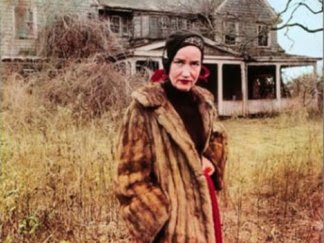
Little Edie Beale, in front of "Grey Gardens," c. 1975, East Hampton, New York. 

Little Edie Beale, who returned to her childhood home in her mid-20s and stayed on there with her aging mother, said it best: "It's very difficult to keep the line between the past and the present. You know what I mean? It's awfully difficult." [As quoted in the Maysles documentary, Grey Gardens, 1975.] My daughter and I watched this documentary the other day for the first time together: it was sad and haunting and we laughed at how things might be if we co-existed together for all of those decades! [I hadn't watched it since with friends back in New Hampshire in 2007: here's a blog post about that viewing.] Unlike Big Edie, I believe in theory that children need to leave the nest and find their own home in the world, too. But as Robert Frost wrote, "Home is the place that when you have to go there, they have to take you in." [From the poem, "Death of a Hired Man"] And we've all had to be taken in from time to time in our lives before going out into the world again.

"But whatever else home is–and however it entered our consciousness–it's a way of organizing space in our minds. 
Home is home, and everything else is not home. 
That's the way the world is constructed." 
Verlyn Klinkenborg, "The Definition of Home," 
Smithsonian, May 2012.

Life provides that constant tussle between feeling at home where we are and longing for what has been. But as I approach fifty, I realize, too, that home can just be in the presence, or mere thought, of a dear friend or family member. A friend back in New England still visits the former homesite of her ancestors: the old house where she spent many summers is long gone but the site is still there, on the shoulder of a mountain, and family members still gather among the ruinous columns and gardens that long ago naturalized into the hillside. While visiting a few weeks ago, she treated a friend and I to a picnic there. In that very special spot it was a tonic to the soul to be able to breathe in the mountain again, the surrounding landscape, the distant hills to the west, and the company of friends on a glorious summer afternoon. For that brief time, all seemed right with the world as we connected with the place and each other.

My children and I outside of Stan Hywet Hall
in Akron, Ohio (built in 1915 by my
great-grandparents, F.A. & Gertrude Seiberling).
Now they love to come here as much as I do.
In Ohio, I return each year to visit the museum home of my great-grandparents and to pass by the home, and other houses, of my childhood. There, in this perfectly preserved museum home, among the photos and the memorabilia, I feel a strange connection with my family and a past that even I did not know. Here in Kentucky the "homeplace" is a revered spot of hallowed ground where a family member once lived. Even if the house is no longer occupied or falling into ruin, it is kept as is, in a kind of stasis, while the fields are mowed or cultivated around it.

Home is as much a place in the mind as anything else and as much comfort as we might have in the world. We can visit former homes in our dreams, as I often do, or in our daytime wanderings or make a home wherever we are. We can be lonely in our homes, surrounded by loved ones, just as we can be homesick for the idea of home.

I suppose it doesn't have to be so complicated and yet, it is.

You come back when you're ready!

Catherine