"Cows are my passion. What I have ever sighed for has been to retreat to a farm and live entirely surrounded by cows–and china." Charles Dickens

August 15, 2011

Farmwife Monday: Canning

A demure 'farmwife' from the late 1940s, probably in The Farmer's Wife or another farm magazine.
I've styled a few pantries in my day for photo shoots but have never seen one as colorful.

It is full-gear canning season here: almost everyone I know is canning something, has been canning, will be canning. This week I will be doing sweet corn on Wednesday (for the freezer), along with some corn relish (canned) and some tomatoes, also canned, on Thursday.

My canning and freezing list for the rest of the season includes, in no particular order:
  • Bread and butter pickles
  • Tomato juice (Lois Bromfield's recipe, just discovered in a cookbook)
  • Tomato catsup
  • Corn, frozen
  • Corn relish
  • Beets, pickled, and also for the freezer (researching that one)
  • Sauerkraut
  • Peaches, pickled
  • Peaches, canned (some––we still have some from last year)
  • Peaches, frozen
  • Peach jam
  • Applesauce
  • Apple butter
  • Grape jam
  • Grape juice
  • Butternut squash (freezer)
I'm probably forgetting something but I do need to start my 'canning plan' for the next few months. My friend Anna and I are doing corn and tomatoes this week (our husbands will shuck the corn!) and in September we will probably go down to a community in Tennessee where her brother lives. They raise muscadine grapes, among other things, and she wants some for wine and jelly.

It's easy to get squirrelly when the cooler days start to come, which they seem to be, a bit. I like to fill the cupboards and the pantry and the freezers for the fall and winter months. And I'm determined to do as little grocery shopping as possible in the next few months. We still have some applesauce, canned peaches and grape juice from last year––and plenty of salsa––so I may not can these items. But the squirrel in me will likely prevail!

Happy canning, everyone! What do you like to put up for your pantries?

Modern day 'war' poster!
World War II era poster for the homefront.


You come back
when you're ready!

Catherine

What I Learned On My Vacation

Old suitcases in a train depot at Green's Heritage Museum in Orient, Ohio.
We took two quick, but much needed, getaways this summer. We don't get away much altogether any more because of the farm. We live within six hours from so many Midwestern and Southern locations but time and again we are drawn back to the place of my birth: Akron, Ohio. I no longer have family there but there will always be a connection to a place that I love. Our daughter has also visited with me there a few times in the past few years. Last month we met great friends from New Hampshire in Akron and then went back another time, just the four of us. I am pleased that our boys now enjoy going there, too, and they even asked for a second visit this summer as our first was not enough.

Here's what we did in no particular order, or, perhaps more importantly, what I learned on my summer vacation:

  • Queen-sized hotel rooms do not have Queen-sized beds in them.
  • Using our Hilton Honors points for free hotel rooms is a great thing.
  • We are on our last days of one room for four of us.
  • Most of Ohio is very flat.
Local people were running up and down these steps for exercise at the McKinley Memorial in Canton.
  • The steps of the McKinley Memorial in Canton are an amazing place for a workout––apparently the locals think so, too. This was my first visit even though I grew up twenty or so miles to the north.
You can safely swim in Lake Erie again––you couldn't when I was a child.
  • Tickling our toes in Lake Erie is no substitute for the Atlantic but our sons were determined to see it.
My friend Linda noticed these steps and I never had before. The Glendale Steps
were a WPA project in Akron, meant to link the neighborhood above with a park near
the Glendale Cemetery (park was never completed). Now the steps are overgrown and appear unused.
 I found out after a quick Googling that it was a project spear-headed by my great-grandmother.

    Every time we visit Stan Hywet Hall and Gardens,
    in Akron, we see something we hadn't seen before.
  • It's amazing what you notice when you are a tourist in your own homeland.
  • Red Lobster® is no substitute for a shore dinner on the ocean.
  • Passing lane hogs on interstates need to be reminded that they are in the passing lane: move over or just move yourselves!

One of the bedrooms at the James A. Garfield National Historic Site in Mentor, Ohio.
  • The National Park Service had money in the 1990s when the James A. Garfield National Historic Site in Mentor, Ohio was carefully and well-preserved, but they still need an "OPEN" sign out front.
  • The library at the James A. Garfield Historic Site
    was my favorite room, but only because the
    kitchen had been torn out for a display area.
  • You know times are tough for historic preservation when an outdoor museum [that I will not mention] is closed several days a week during the summer––and there are weeds in their driveway.
Mr. Green has put together quite a collection of buildings and carriages.

This is the bike one of the American Pickers wanted.
  • Yet there are hidden gems like Green's Heritage Museum, featured on the first episode of American Pickers, in Orient, Ohio. It's open by appointment only: no grants, no budget, no top heavy staffing, just owner-operated and loved. And here you can ignore the weeds.
  • Deer live in the suburbs [we saw three large majestic bucks in the cemetery where my father, grandparents and great-grandparents are buried––it was a magical experience.]
My old grade school building at Old Trail School in Bath, Ohio gets a second story.
I was in the first kindergarten class on the new campus in 1967 (where the large bay window is).
  • I can no longer see my old school from the road in the golden light of morning. Trees grow, fields fill in, barns are taken down. Life goes on. [It's been 40 years, deal with it, Catherine!]
  • My intrinsic mapping abilities are more reliable than the TomTom, as much as I seem to have to prove this to my family again and again.
  • I had never noticed this at the school flagpole until years after.
  • My childhood home––and neighborhood––is smaller each time I visit (but the trees are much larger).
  • If I sit in the backseat with one of my children, I am twelve again, much to the annoyance of my husband up front.
  • In an overpriced antique shop, keep looking. There is often a corner of underpriced stuff (eg. in this case, many reasonably priced books––blog to follow).
  • Don't go shopping after having a gin and tonic at the hotel bar (OK, so the books were on sale at Borders).
Henry, Hunter and Eli share a laugh after dinner.
  • Swenson's double cheesecrackburgers (in the Akron area) are still delicious, every time.
  • Avoid absolutely any store that has "Shoppe," "Ye Olde" or "Amish" in its title: it is none of the above. But we knew this already. It's still annoying.
  • Mrs. Yoder's Kitchen, in Mt. Hope, Ohio, however, is really Amish. And they make the best fried chicken and cracker pudding. Ever.
  • Getting away from the strips (after our chain hotel with swimming pool, of course) and go "off roading" in the place where you visit: it's the best way to experience America.
Everyone is always in stitches by the stories of our friend Andy January, one of my father's 
best friends when he was alive, and who would have given Johnny Carson a run for his money. 
He also has a radio show in Akron, 'My Beautiful Home' on WAKR  (and a family paint store). 
[I was on the show a few years ago––on the phone and later live––to promote The Pantry].
  • Try as you might, you can't go 'home' again.
  • West Point Market in Akron still rocks at 75 years strong but Jungle Jim's in northwest Cincinnati is the Disney World of international food shopping––on steroids.
  • After all that, and three years here now, our return trip to Kentucky felt like coming home.
A collection of old typewriters at Green's Heritage Museum.

And now, let the school year begin! (with more writing time for Mama)

You come back when you're ready!

Catherine

August 8, 2011

Farmwife Monday: Mrs. Miller

Canning beans, farm near Bristol, Vermont  © Louise Rosskam, 1940
"Four-square, high beamed, solid, (the farmhouse) has plain useful furnishings, 
it gives off a certain set, purposeful, stubbornness. 'I am here,' it seems to say. 
'You may take me or leave me. I have work to do. I shall do it. Try and move me.'"
Here is Mrs. Elizabeth E. Miller (aka Grammy Miller), who was 90 years old at the time this photo was taken in 1940 (she was born in 1850 if you can imagine that). She was of Scotch-Yankee ancestry, lived on Mountain and Lake View Farm in West Newbury, Vermont and had four boys: Clarence, John, James, George and one daughter who died in infancy.

She was interviewed in 1938 by Rebecca M. Halley (see above quote or entire manuscript here), and later photographed, above, as part of the Federal Writers' Project under the Works Progress Administration (WPA). Created as part of the New Deal in 1935, the WPA was responsible for employing people to build highways, public buildings, and some infrastructure. They also sent unemployed photographers, writers, artists and even musicians across the country––and paid them, too––to document, or enhance, rural life during the Great Depression. Of note is that many of these writers and photographers were women, such as Louise Rosskam, Dorothea Lange and Marion Post Wolcott. This may explain the abundance of interior kitchen scenes and portrayals of rural farm women across the country from this initiative.

Here is an excerpt from that interview:
One fall we had a five hundred and fifty pound dressed hog hanging in the yard. The men went off to Wells River to take up another hog they had dressed at the same time and left it hanging there and the caldron kettle half full of water. They aimed to get back and take the hog down to cellar before it froze. It would never do to let pork that was going to be salted freeze. I was all alone with the children and I waited until almost twelve. My husband didn't come and so I took a lantern and a saw and a knife and went out to fetch in that hog...I cut up that hog and loaded it piecemeal onto the sled. The worst part was getting it through the front door, but I managed. I had it all done before my husband got home. He asked who had brought the hog in. I said, 'I did.' He asked who helped and I said, 'Alone.' I wasn't wasting many words on him. He was struck dumb.
You can also hear Mrs. Miller speaking here. [I so enjoy listening to older accents: you can detect some Scotch dialect and also some Yankee accent in her voice.]

The online archive of the Library of Congress––our national library in Washington, DC that you own it––is tremendous. There are many images and audio archives available on the Internet. Here is a link to their "American Memory" archive where you can do a more refined search on many documents, images and audios, including the WPA collection.

There are numerous books on the WPA photography from this era but another more recent book I highly recommend is The Food of a Younger Land––A Portrait of American Food from the Lost WPA Files by Mark Kurlansky. Drawing on the unpublished writings that drew from the WPA interviews and photographs depicting farm life around 1940, the book documents the pre-War period of time in America when life was still largely agrarian for many and food was truly local.

You come back when you're ready!

Catherine

August 2, 2011

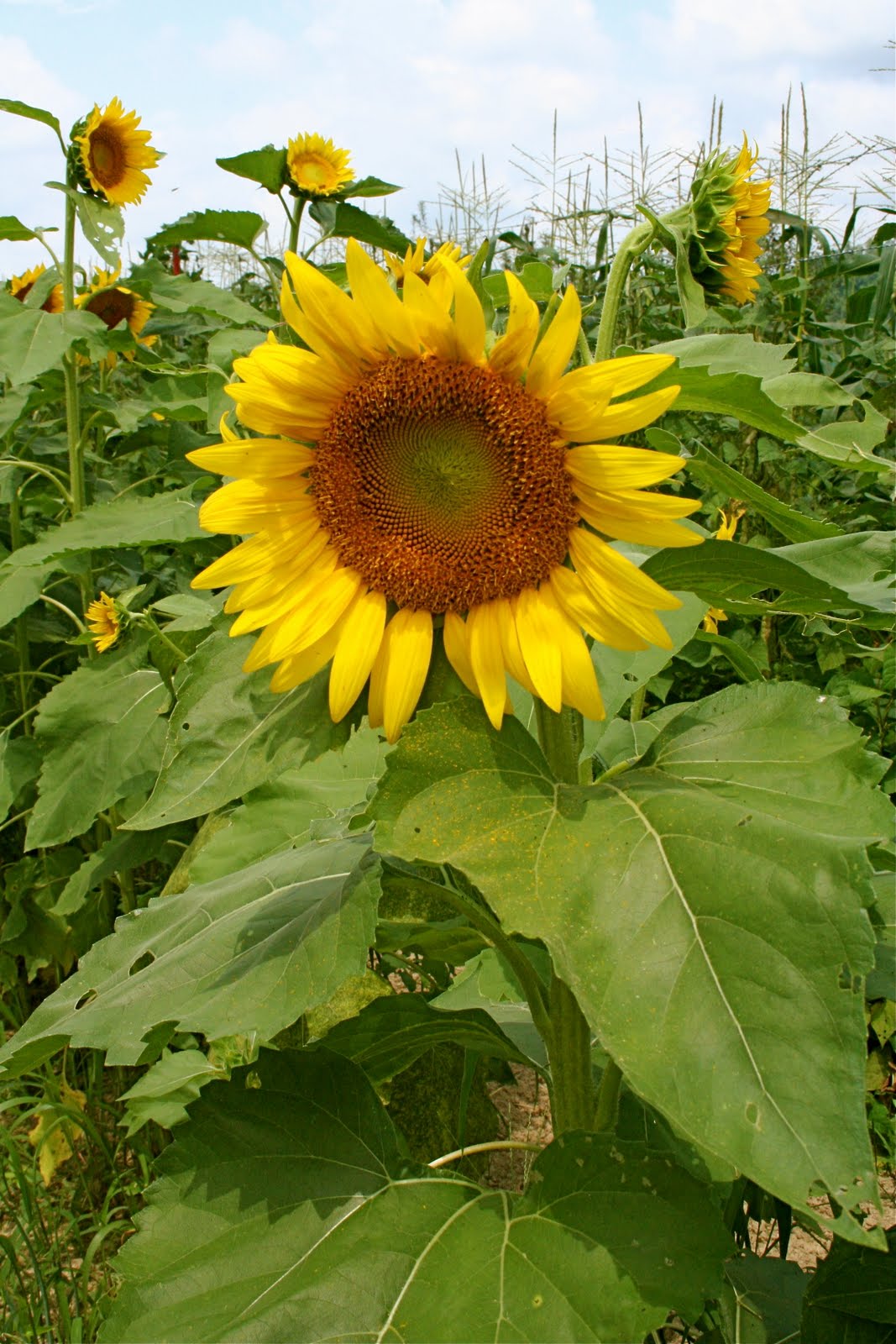
A Sunflower Trail

Sunflowers along the roadside growing in an
Old Order Mennonite vegetable garden in nearby Casey County.

'The new country lay open before me: there were no fences in those days, and I could choose my own way over the grass uplands, trusting the pony to get me home again. Sometimes I followed the sunflower-bordered roads. Fuchs told me that the sunflowers were introduced into that country by the Mormons; that at the time of the persecution when they left Missouri and struck out into the wilderness to find a place where they could worship God in their own way, the members of the first exploring party, crossing the plains to Utah, scattered sunflower seeds as they went. The next summer, when the long trains of wagons came through, with all the women and children, they had a sunflower trail to follow. I believe that botanists do not confirm Jake's story but, insist that the sunflower was native to those plains. Nevertheless, that legend has stuck in my mind, and sunflower-bordered roads always seem to me the roads to freedom.'

~ Willa Cather, My Ántonia (1918) 


You come back when you're ready!

Catherine

August 1, 2011

Farmwife Monday: Mammy and her Chickens


This photo shows Elizabeth (Lizzie) Sweeney Wells, c. 1924, with her flock of chickens. Lizzie was the grandmother of Joberta Wells, who submitted this photograph. Joberta lives on her grandmother's farm, just outside of Yosemite, in nearby Casey County, and in recent years recreated the classic three-gabled farmhouse from the foundation up. [Joberta is a friend and also a columnist at The Casey County News.]

Farm women were often photographed with their chickens and it is one of the most common scenes depicted in old farm photographs. Women tended the flocks on small amounts of land around the farmhouse or yard and gathered the eggs. Their 'egg money' was a valuable asset to farm income and their flock would have been a source of personal pride. Tending chickens was also an area where younger children could assist, including feeding and egg-gathering.

In an excellent paper on The Contemporary Farm Woman: 1860 to the Present, published by the Central New York Resource Conservation and Development, Inc. [Isn't the Internet amazing?] Stephanie Fisher writes:
"Women could exercise complete control over the production and income of their chickens. However, women often chose to spend the money to assist the farm or farm home. During hard economic times, the egg money, known as ‘pin-money,’ often saved the farm when their husband’s commodities failed to provide income...Women’s participation in chicken farming and the production of eggs continued until around the 1940s."
[World War II changed society and farming practices, after which factory-farming became more prevalent. However, in many rural areas, such as Casey County and throughout much of Kentucky, sustenance farming continued, much as it does today with household gardens, chickens and other livestock to support the family.]
Do you have a photo of a farmwife in your family to share on this blog? If you do we are happy to publish it or post a link to your blog.

NOTE: For two excellent first-hand period accounts of life with chickens, read Betty MacDonald's classic The Egg and I, written in 1945 and made into a movie (that launched the popular Ma and Pa Kettle films) or Mildred Armstrong's recent best-selling account of Midwestern farm life in the 1930s, Little Heathens–Hard Times and High Spirits on an Iowa Farm During the Great Depression

+   +   +

Thanks to Joberta Wells for her contribution to this entry.


This blog post also appeared recently in the 'Farm Attic' section of GROW Casey County, a blog about local produce and agricultural happenings––as well as our local Old Order Mennonite community––in Casey County, Kentucky. Here's a 'Part Two' to the blog: Farm Attic: Part 2 on Chicken Farming.

You come back when you're ready!

Catherine